City Budget Faces New Challenges
PROTECTED CONTENT
If you’re a current subscriber, log in below. If you would like to subscribe, please click the subscribe tab above.
Username and Password Help
Please enter your email and we will send you a password reset link.

DAVE’S WORLD
By David Howell
City officials are fine-tuning the budget for the new fiscal year beginning in October, and it will present some unusual challenges.
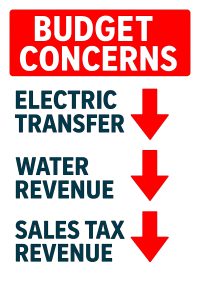
One of the big questions on the table is the PILOT payment—short for Payment in Lieu of Taxes. This is the money the city receives from the electric department each year, transferred into the general fund. The electric commission has asked for a 10 percent reduction in that payment.
For perspective, the PILOT this year is budgeted at $588,000. A 10 percent cut would mean $58,000 less for the city, or $529,000. That’s not pocket change, but it should be an amount both sides can manage.
The payment is based on the taxable value of the electric department—lines, transformers, poles, equipment, and other assets. A formula is used to figure the amount of the PILOT, but the amount can also be adjusted by city officials.
Over the last 20 years, the PILOT has nearly doubled—from $311,049.99 in 2004 to just under $600,000 today. In other words, nearly $600,000 is being pulled each year from a department with a $7 million annual budget.
The largest jumps in the PILOT payment came in 2020 and 2021. In 2020, the PILOT rose from $406,418 to $479,115. The very next year, it climbed again to $532,529. With that kind of increase, it’s easy to see why city and electric officials are negotiating an adjustment.
And that’s only one challenge facing the budget. Another problem is a sharp decline in water sales—down about 30 percent this year with no clear explanation yet.
Then there’s sales tax revenue, one of the city’s most important income streams.
 Here’s how that works. In Mississippi, when you shop in a store or eat in a restaurant, you pay the seven percent state sales tax. The state keeps most of it, but 18.5 percent comes back to the city where the sale happened. That’s called the “diversion.”
So, if Water Valley businesses generate $100,000 in taxable sales in a month, $7,000 in tax is collected. Of that, the city’s share is about $1,295. It doesn’t sound like much, but multiplied over a year it becomes one of the largest revenue sources that keeps City Hall running. And importantly, it only comes from purchases made inside the city limits.
But here’s the problem. The June report from the Mississippi Department of Revenue showed Water Valley received $671,260.75 in sales tax diversions in Fiscal Year 2025 (July 1, 2024 – June 30, 2025). That’s down about 2.9 percent from $690,951.10 the year before. I’m no budget guru, but I expect online sales are playing a role in this decline of shopping in Water Valley’s brick and mortar stores.
Add it all up—less from the electric department, less from water sales, and now less from sales tax—and you can see why the budget will be difficult to balance this year.
Even property taxes didn’t deliver the boost officials were hoping for. Back in March, Tax Assessor/Collector Michael Walton told us to expect a 20 percent increase in the taxable value of real property countywide. But in Water Valley, the increase came in at just six percent, generating an additional $75,000 in revenue. As Mayor Tommy Reynolds explained last week, the city’s tax roll took a hit in personal property values, which offset gains from rising home values.
Since I mentioned online sales, it’s worth noting there has been one big positive. In 2018, the Mississippi Legislature adopted a use tax as part of a broader effort to level the playing field for local retailers. The law went into effect July 1, 2020, requiring online sellers who meet certain thresholds to collect and remit the tax.
In simple terms, if you buy something online from an out-of-state seller, Mississippi now collects a use tax on it. That money is distributed to counties and municipalities using a formula that factors in both population and road mileage for counties and cities.
For Yalobusha County, this has turned into a game-changer. The use tax now brings in more than $1.3 million a year for roads and bridges. In January, the county received a check for $638,637.49, and another in July for $696,422.57—a combined total of $1,335,060.06 this year. The money is divided equally among the county’s five beats, giving each supervisor a steady pot for paving and repairs.
That’s a big increase. In fact, the county’s own road and bridge tax levy for the upcoming fiscal year is $1,124,335—which means the use tax now contributes more than local taxpayers pay when buying a car tag or paying property taxes. Think about that: five years ago this revenue didn’t even exist, and now it has surpassed local taxes as the largest source of money for road and bridge work.
Funny how it works — the same online sales that are paving county roads are also cutting into the city’s sales tax check. What helps the county budget ends up hurting City Hall. So if you click “buy now,” just remember — you might get a smoother ride to town, but fewer shops once you get here.