Electric Commission Explores Partnership With MSU for Grid Work
PROTECTED CONTENT
If you’re a current subscriber, log in below. If you would like to subscribe, please click the subscribe tab above.
Username and Password Help
Please enter your email and we will send you a password reset link.
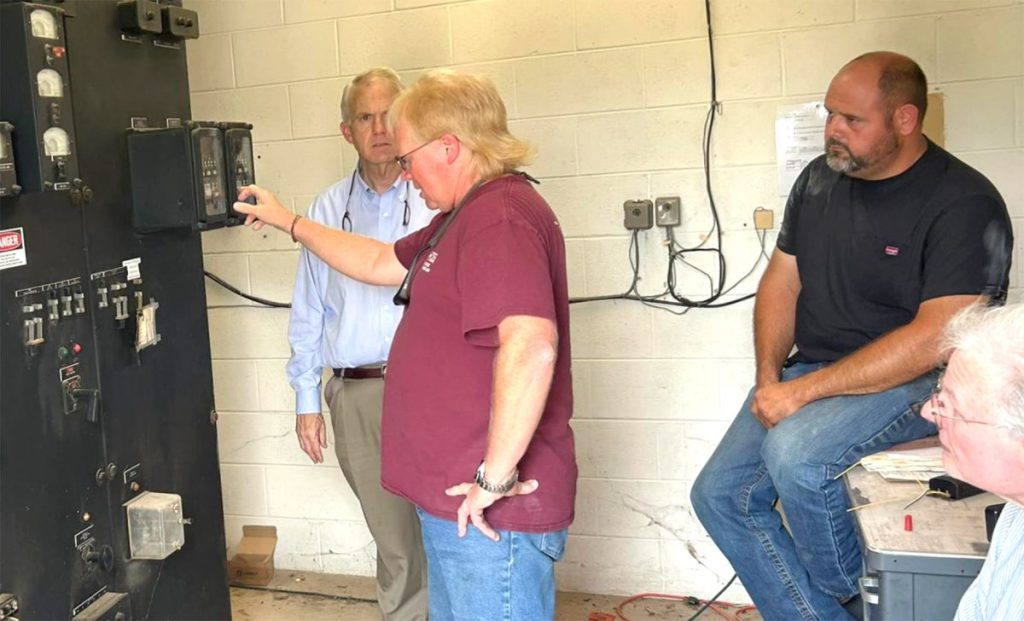
Dr. David Wallis (center) of Mississippi State University examines equipment inside the Water Valley substation control building with Electric Commission Chairman Brandon Presley (left), Superintendent Michael Richardson, and Commissioner Barry Weeks during a site visit following Thursday’s meeting.
WATER VALLEY – The Water Valley Electric Commission is looking to Mississippi State University for help tackling decades of underinvestment in the city-owned electric system. At a Thursday, August 21 meeting at Everest, commissioners hosted three MSU officials — Dr. Dallas Breen, executive director of the Stennis Institute of Government; Dr. David Wallis with the Paul B. Jacob High Voltage Lab; and Dr. Robert Green, associate dean of academics.
Commission Chairman Brandon Presley said the visit could mark the start of a strategic partnership that brings both technical insight and hands-on student support to upgrade the system that serves 2,100 customers.
“We’ve got a lot of issues here—infrastructural, mechanical, operational,” Presley told the group.
He reminded the visitors that Water Valley was among the first towns in Mississippi with electricity, dating back to 1894. But over time, the system suffered from a lack of reinvestment and years of revenue being diverted to city coffers. Today, the system depends on a single Tennessee Valley Authority (TVA) interconnection to feed the entire city, with nearly 90 percent of customers served by one feeder line.
“Any single failure is obviously a problem,” Presley said. “And our 4 kV copper lines are losing power at nine times the rate of a modern system.”
One-time funds, long-term needs
The commission has already applied for $3 million in grants — $2 million from the Delta Regional Authority and $1 million from the Mississippi Development Authority — and has contracted $372,000 for right-of-way clearing to directly reduce line loss. Up to 180 poles are expected to require replacement in an upcoming wholesale inspection, a project currently in the bid process.
Presley said the funding in play is “one-time money” that must be stretched as far as possible with the help of MSU. “This is a hell of a story for Mississippi State to be part of telling,” he said. “It’s a new governmental agency being stood up, and once we fix it, the benefits will be exponential.”
He added that MSU students and faculty could play a direct role through capstone projects, internships, or engineering analysis. “We are, quite literally, flying the plane while we’re building it,” Presley said, noting that in its first month the commission barely managed to cover a payment to TVA for the purchase of electricity.
AMI meters and SCADA
Much of the discussion with MSU officials centered on technology upgrades, especially the Advanced Metering Infrastructure (AMI) system and how it ties into a future SCADA system expected to be implemented on the grid.
Electric Department Superintendent Brandon Richardson reported about 40 three-phase meters still need to be converted to AMI, in addition to over 100 residential meter conversions.
“On the three-phase, where we are losing the real money, would it be wise to get a contractor to come in and get those things swapped out?” Presley asked.
Wallis recommended making the upgrade a priority, especially replacing all three-phase meters with AMI, also known as smart meters.
“By improving that, you will improve revenue,” Wallis said. “Not only do you replace the meters, but you seriously want to look at the instrumentation feeding the meters.”
Presley noted the commission has about $400,000 remaining in unallocated legislative funds that could cover the cost. “Some people think we got a little hard-headed on this,” he said about the project to switch to AMI meters that was launched almost three years ago. “ But we cannot get the full benefits of AMI until the whole system is on it.”
Wallis also stressed the importance of the AMI conversion, explaining that the full benefits are only in play once all meters have been replaced.
“Once it is all computerized, SCADA is going to tell us what’s happening. It will dispatch that crew before anybody calls to report their power out. If you have a fault, it will tell you exactly where it is so you’re not wasting time tracking it down. It increases revenue through meter accuracy, it prevents theft, and it improves reliability.”
SCADA, short for Supervisory Control and Data Acquisition, is described as the “nervous system” of a modern utility. It links smart meters, sensors, and control equipment so operators can see problems in real time, pinpoint outages, and reroute power remotely.
Wallis stressed this is why moving ahead with full AMI deployment is critical.
Looking ahead
Before the meeting adjourned, Presley asked the MSU team to imagine if all the grants now in the works are awarded, jump-starting the grid upgrades.
“We don’t want to be the dog that caught the car,” he said. “We want to know what we’ll do with that investment and how to make the most of it.”
Dr. Green and Dr. Breen outlined ways MSU students could be integrated into the work, from co-op assignments to capstone design projects in coordination with the city’s engineers, Atwell and Gent.
“This is generational work—fixes that will last 40 or 50 years,” Presley said. “If we do this right, Water Valley—with just 2,100 customers—can become a model utility. We can go from rags to riches. This can be a case study for other small towns across Mississippi.”
Following the meeting, commissioners Presley, Terry Allen Jr., and Barry Weeks joined the MSU officials for a site visit to the city’s substation.