Elvira Struts To Fourth Place In Kentucky Contest
PROTECTED CONTENT
If you’re a current subscriber, log in below. If you would like to subscribe, please click the subscribe tab above.
Username and Password Help
Please enter your email and we will send you a password reset link.
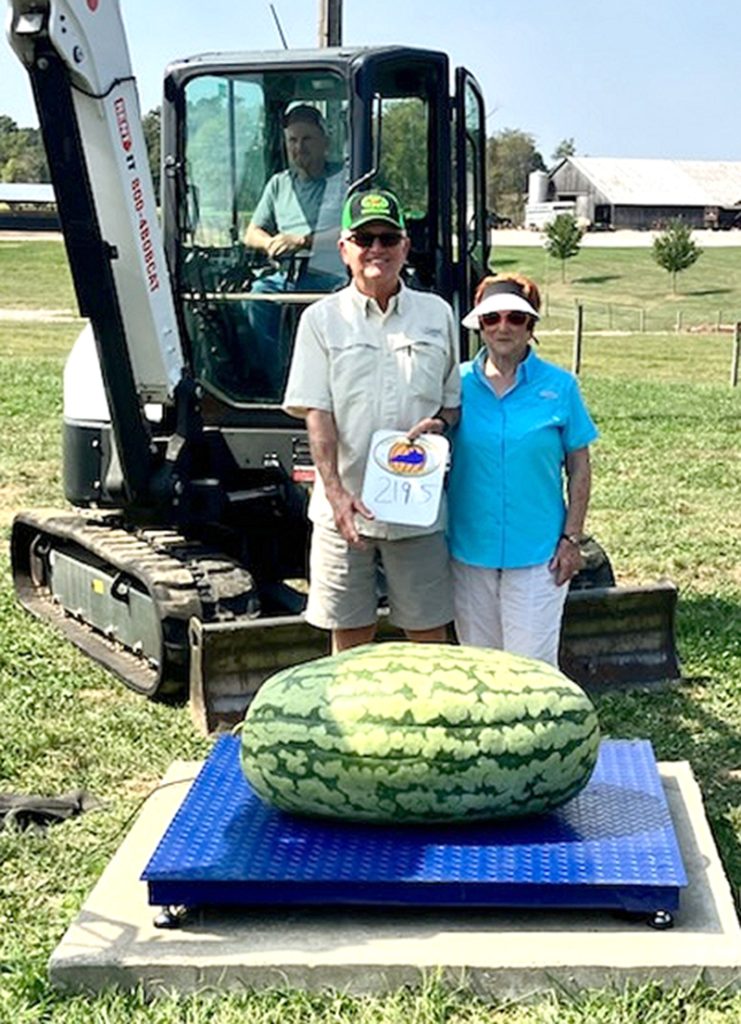
Allen and Martha Rogers stand with their prize watermelon “Elvira” at the Kentucky contest last Saturday.
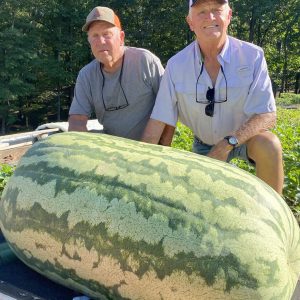
WATER VALLEY – She may not have the polish of Josephine, last year’s record-setting beauty, but Elvira proved she had enough weight to hang with the best. The 219.5-pound watermelon grown by Allen and Martha Rogers finished fourth last Saturday, Sept. 20, in the Great Pumpkin Pursuit & Watermelon Weigh-Off at Roberts Family Farm in Guston, Kentucky.
Rolled carefully onto the scales after months of tending, Elvira became the latest chapter in Water Valley’s long claim as the Watermelon Metropolis of the World. And the Rogers wasn’t the only Yalobusha County names called from the winner’s list. Former state record holder Hal Vaughn entered a 162.5-pound melon that placed ninth, giving the county two melons in the top ten of a national-caliber contest.
Getting Elvira to Kentucky was no easy feat. Rogers planted the vine on April 15, but a wet May and June nearly ended her story before it began. Heavy rainfall brought fungus that claimed several promising melons around the county, including one in Tom Hill’s patch that Rogers believes could have reached 300 pounds. “That watermelon may have reached 300,” he claimed. Even Elvira wasn’t perfect. She grew squat and flat-topped, “a little squattier than Josephine,” Rogers admitted, referring to last year’s 274-pounder that set a Mississippi state record and finished second at the same Kentucky weigh-off.
Still, she kept gaining. By mid-September her circumference stretched to 66 inches, with growth of up to half an inch a week. Rogers fed her one last meal on Sept. 16 before the Kentucky trip.
Though Allen is the one in the patch pruning vines and measuring growth, he insists Martha is just as much a part of the operation. She travels with him, helps tend the plants, and will soon enter her own melon in an October contest in Tennessee. “We both enjoy it,” he said. “It’s something we do together, and we’ve made a lot of friends through it.” That spirit of friendship extends to Vaughn as well. The two growers are rivals on paper but partners in practice, constantly trading tips, seeds, and encouragement. “I can’t thank Hal enough for getting me started,” Rogers said. “He’s my mentor, but we still try to beat each other.”
Water Valley’s reputation for monster melons goes back to 1999, when the Carolina Cross variety first appeared in the annual Watermelon Carnival with a 100 pounder. The watermelon Rogers and Vaughn and others before them have pushed that tradition to new levels.
Josephine’s 274-pound mark in 2024 edged Vaughn’s 271-pound melon, which had set the record just weeks earlier. Both men borrowed methods from nationally known growers, experimenting with soil microbes, bushel gourd grafting, and even building wooden walkways over their patches to protect delicate vines. This year, the weather dictated a more modest outcome, but a fourth-place finish in Kentucky still keeps Water Valley in the national conversation. The contest attracts growers from across the country, including Kentucky’s Nick McCaslin, whose 306.5-pound entry took top honors. Rogers admired his competitor’s season. “Nick’s been awesome this year,” he said.
Rogers admits it’s hard not to measure every new melon against Josephine, the star of 2024 and current state record. “Josephine was a better watermelon,” he said simply. She had shape and size, stretching the scales to a record that may stand for years. But Elvira held her own in a season stacked against growers. “If you raise a 200-pound watermelon, you are really doing good,” Rogers said. “That’s an accomplishment in itself.”
Rogers has another melon he will likely name Caroline that is destined for a Tennessee weigh-in in October, the last of the season. Martha has one she plants to enter herself.
Looking ahead, Rogers is already drafting his playbook for 2026. He talks about soil health, about microbes as “the balance of nature,” about finetuning the grafting process watermelons are connected bushel gourd vines for bigger root systems. He remembers watching what top growers like Frank Mudd and McCaslin do, borrowing what makes sense, and trying it all back home to Mississippi soil.