A Reminder As Tornado Season Nears
PROTECTED CONTENT
If you’re a current subscriber, log in below. If you would like to subscribe, please click the subscribe tab above.
Username and Password Help
Please enter your email and we will send you a password reset link.
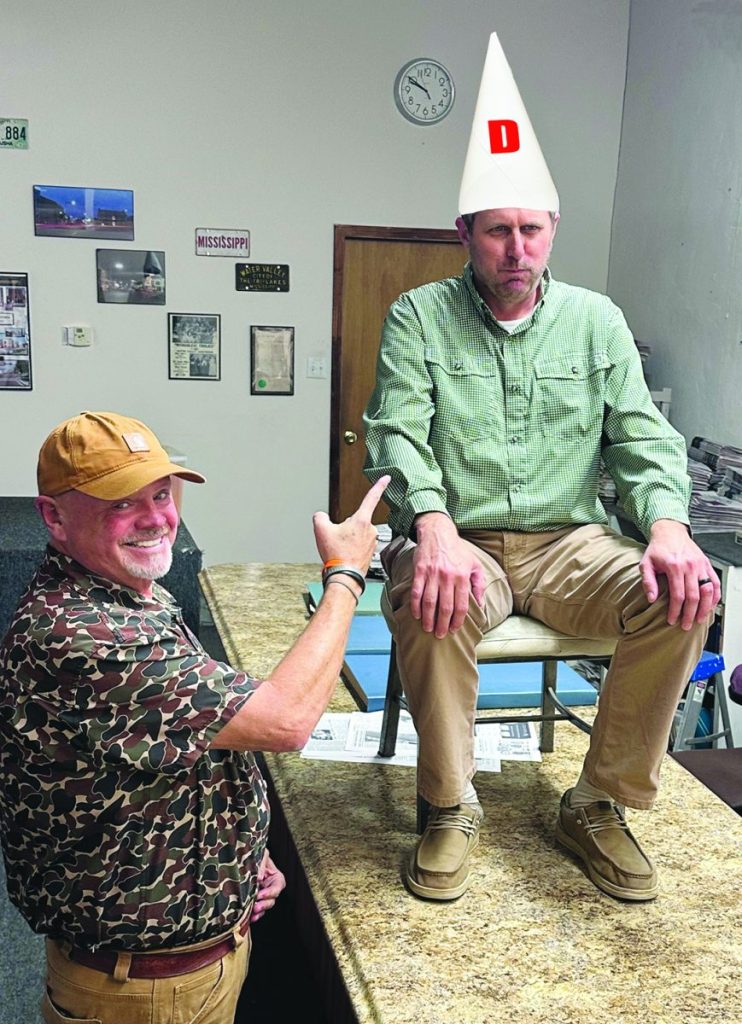
Wearing the official office-issued dunce hat, Editor David Howell takes his punishment as Robbie Ferguson points out the obvious — a reminder that even journalists need cybersecurity lessons.
You may notice changes in the paper this week. This redesign has been in the works for a while, and it’s part of a larger effort to make sure the Herald is somewhat modern and looks consistent across both print and digital platforms. In today’s newspaper business, those two worlds have to work together.
Times are certainly changing in this business, and whether we like it or not, a stronger digital presence is no longer optional. We’re trying to move forward thoughtfully, without losing what makes a small-town newspaper feel like home. I suspect 2026 will be a challenging year and I despise change. We’d love to hear your feedback.
Now, back to our regularly scheduled programming.
Yalobusha County Emergency Management Agency Director Stewart Spence shared an update at Monday’s Board of Supervisors meeting about the never-ending task of keeping antiquated tornado warning sirens operational across the county. Problems were reported at dispatch and throughout the western end of Yalobusha County, including the Skuna Valley and Tillatoba fire departments, along with a siren at the Beat Five County Barn.
Spence is working to get the various issues resolved—problems ranging from failed battery backups and radio issues to full motherboard failures. With tornado season fast approaching, there was a clear sense of urgency surrounding the repairs. Spence also warned that many of the sirens are nearing the end of their useful life, making breakdowns more frequent and repairs more costly. He reported the cost during the last year on siren maintenance is a little over $17,000.
That discussion sent my mind on an earlier Herald edition. While Grant Thompson was digitizing old editions Tuesday morning, I glanced at a front page dated Feb. 25, 1971. Fifty-five years ago, the entire front page was devoted to tornado damage in Tillatoba. A twister destroyed 10 homes in and near town and seriously damaged others. The storm struck on Sunday morning, Feb. 21, and was one of more than 50 tornadoes reported across Mississippi, leaving an estimated 90 people dead.
It was a sobering reminder. In Mississippi, you never really know when a tornado outbreak can occur. And judging by how warm this Tuesday morning feels for early January, Mother Nature doesn’t always follow the calendar.
Here’s my point: tornado sirens are helpful, but they are not foolproof.
I am not arguing for eliminating sirens. They absolutely have a role. But we should not depend on them alone. Sirens were designed primarily as outdoor warning systems, not indoor alerts. They malfunction. Batteries fail. Power goes out. And sometimes, you simply don’t hear them.
Most of us now carry something far more reliable in our pockets.
The vast majority of people have smartphones, and the built-in emergency alerts on those devices are often faster and more dependable than sirens. There are also numerous free weather apps that provide real-time warnings.
In addition, Yalobusha County pays $1,500 annually, in partnership with the North Central Planning and Development District, to provide CodeRED services. CodeRED delivers severe weather alerts through voice calls, text messages and emails and works for landlines as well, which is especially important for elderly residents who may not use cell phones.
Ironically, as the problems with weather sirens were being reviewed during Monday’s Board of Supervisors meeting, I checked the sign-up link for CodeRED on the county’s website, yalobushaonline.org, and found it was down. The same link was also unavailable on the North Central Planning and Development District’s website, so this was not a county-specific malfunction.
I guess antiquated sirens and modern technology can both fail.
However, Yalobusha County residents who need assistance signing up for CodeRED can contact Robin Harrington at the E-911 office in the Coffeeville Courthouse at (662) 675-2556.
Again, this isn’t an either-or argument. Sirens are one layer. Phones are another. The more layers we have, the safer we are.
For background, there are 11 tornado sirens in Yalobusha County, with five in the City of Water Valley and two in the Town of Coffeeville. It is not unusual for sirens to malfunction. While most county sirens have battery backups, those batteries can fail between routine tests. Most of Water Valley’s sirens do not have battery backups and will not function during a power outage.
Technology has changed. The weather has changed. Our habits need to change, too.
Dave’s World, Part 2
My column originally ended here, but this week we’re going to have a Part 2 after developments Tuesday morning warranted it.
This one comes with a lesson learned — and yes, I am the dummy in the story.
Monday morning, I received a Facebook message from a teacher at the elementary school asking if she could send me a link to a clothing product line she was getting ready to launch. Honestly, I didn’t think much about it. People reach out to me all the time with human-interest ideas, and I’ve even written stories about local folks launching clothing lines. (Well, once.)
Tuesday morning rolled around and I was already behind, trying to get some work done early before the office opened, when I got another message from her asking if I had received the link. I was busy and quickly replied no, but said I’d be happy to schedule an interview for a story.
“Great,” was the response.
Then “she” asked for my phone number so she could send the invitation link to the Instagram account for the clothing line so I could see it.
For some reason, no alarm bell went off.
Then “she” asked for my email address.
Still no alarm bell.
Then “she” asked for my Gmail address.
Still nothing.
It kept going on and on because, supposedly, I couldn’t get the link to work. Finally, when the registration still wouldn’t work, “she” asked if we could just set it up directly using my password.
About that time, Thompson arrived at the office and started helping me figure out why I couldn’t find the Instagram link to link. Meanwhile, this person just kept messaging.
Thompson was immediately suspicious — as I should have been.
I had to explain to him that this was for a story, which is why I was being cooperative. When the request came for my Google account password, Grant calmly reminded me of something I already knew:
You do not send a password to anybody — ever — for any reason.
I knew that. I really did. But somehow it never crossed my mind that someone had obviously hacked this person’s account and was now trying to hack mine.
The scary part? I have passwords stored in emails in my Gmail account that they could have accessed. Thankfully, I never gave that information. I did realize I had likely allowed access to my Instagram account, so I immediately changed my passwords — Instagram, Facebook, Google and, for good measure, my online banking password. I hadn’t changed that one in years.
I was fortunate.
But now I understand just how easily it can happen.
As the morning went on, it slowly sank in just how dumb I had been. And the only reason I’m sharing this is because I realized something else: I have been critical of people who fall for scams like this.
And then I fell for one.
When Melody got to work, she made me a dunce hat for good measure. When Robbie Ferguson stopped by the office later, they put my chair up on the counter and took a picture.
Yep. If the hat fits.