Higher Costs Squeeze County
PROTECTED CONTENT
If you’re a current subscriber, log in below. If you would like to subscribe, please click the subscribe tab above.
Username and Password Help
Please enter your email and we will send you a password reset link.
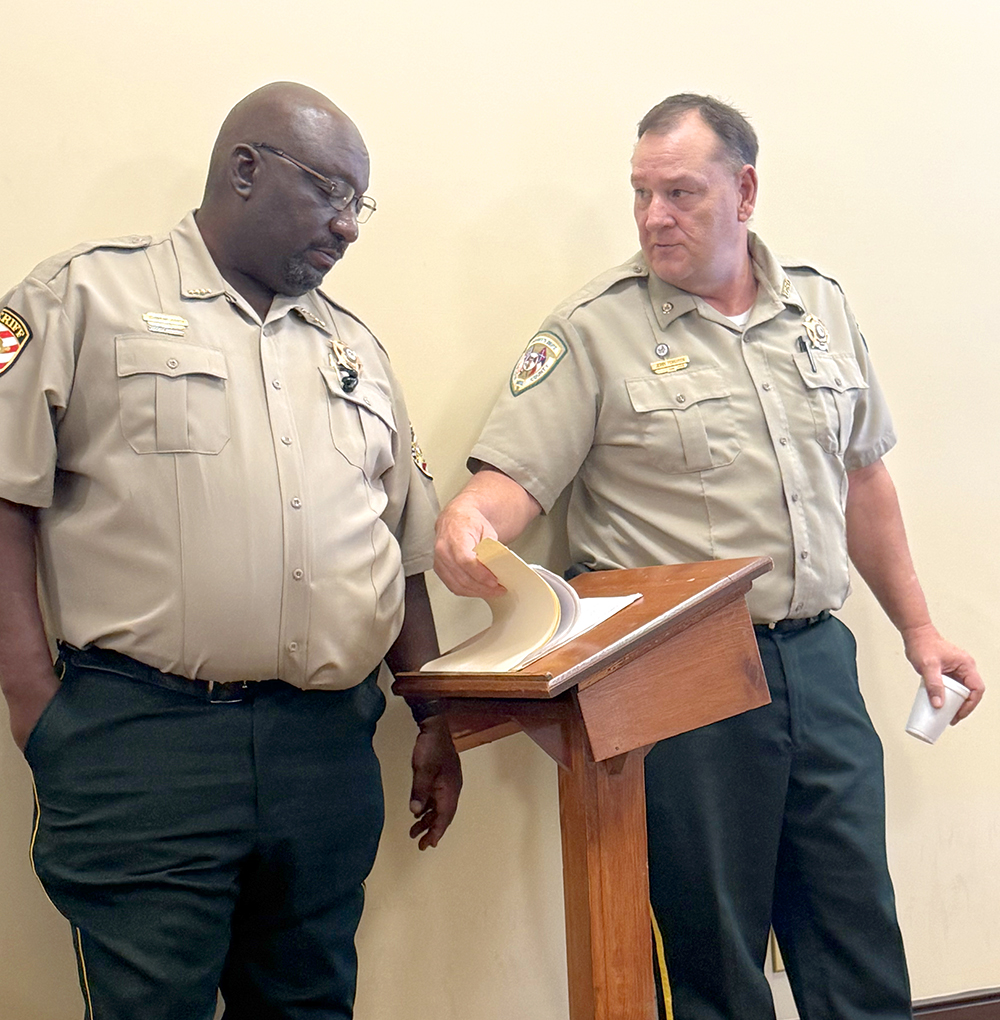
Yalobusha County Sheriff Jerimaine Gooch (left) and Deputy Jerry Ferguson attend Monday’s budget meeting.
WATER VALLEY – Yalobusha County supervisors will hold the county property tax rate steady and forego employee raises in a tentative budget adopted Monday as sharply higher health insurance and retirement costs put pressure on county finances.
The spending plan calls for a $217,267 increase in General Fund spending for the fiscal year beginning Oct. 1. Supervisors opted to leave the property tax levy unchanged at 50 mills. However, growth in the county’s taxable assessed value is expected to generate approximately $147,500 in additional property tax revenue during the coming fiscal year, according to the budget report at Monday’s meeting.
After accounting for the additional tax revenue and other anticipated revenue, the tentative budget leaves a $60,767 gap that supervisors expect to cover through the county’s General Fund surplus or potentially FEMA reimbursement from storm recovery expenses.
The budget discussion began with considerably more on the table.
Department heads had submitted requests that would have increased General Fund spending by $574,235, from the current $5.86 million budget to approximately $6.43 million. Supervisors worked through the requests department by department, generally keeping increases needed to cover higher employee health insurance costs while eliminating requests for additional salaries and other expenses.
The largest request eliminated came from Sheriff Jerimaine Gooch, who sought funding for four additional jailers.
The request included $299,950 for jailer salaries and another $57,407 in state retirement costs. The original request would have increased the jail budget from $480,472 to $841,693.
Supervisors did not fund the four new positions but retained the increase needed for health insurance.
Board President Cayce Washington emphasized that the decision was not a reflection on Gooch’s management of his department.
“The sheriff has done an excellent job of managing his resources, better than any sheriff since I’ve been on this board,” Washington said.
Supervisors also removed a requested $4,200 salary increase from the coroner’s budget and eliminated a $1,900 increase requested by the Extension Office that included $500 annual raises for three employees and associated costs. They also declined an additional $700 contribution requested for the county’s 4-H program.
In the Civil Defense budget, supervisors retained a $4,224 increase for group health insurance but eliminated the remainder of an $18,744 requested increase. In E-911, supervisors kept a $26,112 increase for group insurance but eliminated the other requested increases.
As supervisors worked their way through the budget, the discussion eventually turned to whether there was enough money to provide raises for county employees.
“The elephant in the room, are we going to try and give our employees any kind of increase this year?” District 4 Supervisor Eddie Harris asked.
Harris said the question had already come up repeatedly.
“I have been asked that question more than one time, several times,” Harris said.
Ultimately, supervisors decided there was not enough room in the tentative budget for employee raises, particularly with the county already facing substantially higher benefit costs.
“I always want to give raises, but I think since we have given raises the last few years, they were pretty decent,” Washington said. “But the cost of living went up too. The health insurance is a big factor.”
Instead of going toward raises, much of the county’s increased spending will go toward employee benefits, with health insurance costs rising $177,880 and state retirement costs increasing $11,152.
“There are your raises right there,” Washington said.
The county’s Blue Cross Blue Shield health insurance premium jumped 56 percent for 2026, increasing from $627.07 to $977.02 per employee per month. The county provides health coverage for an estimated 62 employees through a Blue Cross Blue Shield plan combined with a secondary gap plan.
District Five Supervisor Gaylon Gray recommending looking at other insurance options.
“Need to check and see if anyone else can do us better,” Washington agreed.
Chancery Clerk Donald Gray said the county should look, but cautioned that its recent claims history could make finding a less expensive plan difficult.
“We need to, but I am afraid our loss ratio will be so bad,” Gray said. “We have had a couple of employees who had some major issues.”
Supervisors also worked through requests outside the General Fund.
E-911 had requested an increase of $110,343, which would have taken its budget from $564,105 to $674,448. The request included $26,112 for higher group insurance costs along with increases for telephone service, maintenance contracts, equipment, training and other expenses. Supervisors retained the insurance increase but rejected the other increases.
While employees will not receive raises under the tentative spending plan, supervisors also decided against increasing the county’s property tax millage rate.
The county’s taxable assessed value increased by $2,348,652, or about 2.6 percent, to $92,513,155 for the coming fiscal year. That growth allows the existing 50-mill county levy to generate an estimated $147,500 more than it did under the tax roll for the current 2025-2026 fiscal year.
While the county’s millage rate will remain unchanged, District 2 Supervisor Gaylon Gray noted that some property owners could still pay more if their assessed values increased.
“You could pay a little more if your assessed value on your property increased,” Gray said.
The additional revenue generated by growth in the tax roll brings the remaining General Fund gap to $60,767 under the tentative spending plan.
Supervisors decided to that amount through existing General Fund reserves or potentially using FEMA reimbursement associated with storm recovery expenses if needed.
The approximately two-hour work session was one of the county’s quicker budget discussions in recent years. The tentative budget and tax levy are not yet final. A public hearing is tentatively scheduled for Sept. 9, with formal notice of the hearing to be published twice in the Herald before supervisors take final action on the budget for the fiscal year beginning Oct. 1.