Supervisors Continue To Defend Justice Court Merger

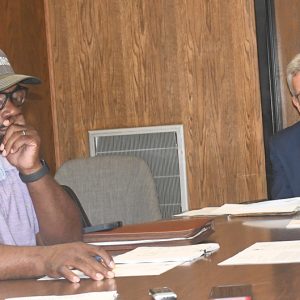
Former supervisor Henry Dean Gray (left) and District 1 Supervisor Tommy Vaughn discussed the consolidation of the justice court office in the county during Monday’s supervisor meeting. – Photo by David Howell
Former Supervisor Grills Board
By David Howell
Editor
COFFEEVILLE – Supervisors defended a decision to combine the justice court offices following a heated back-and-forth discussion with former supervisor Henry Dean Gray.
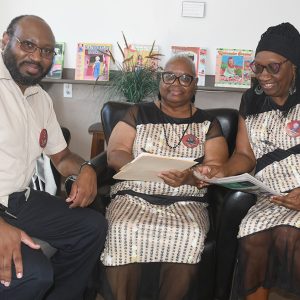
“I am here to rescind that order moving our justice court clerk out of this district into another court district,” Gray told supervisors during the first meeting in 2010 held Monday. With Gray was George Harrison and Eddie Simmons.
Gray was referring to a 4-1 vote during a meeting last November to consolidate the justice court offices in the Water Valley and Coffeeville courthouses to one location – the Carothers building located two miles south of Water Valley.
Monday’s discussion also covered other county issues, including the courthouse renovations, apparent problems in justice court system, and the acquisition of the Carothers building by the county, as Gray grilled supervisors.
Gray first questioned the expense of preparing the Carothers building, then followed with questions about the location of the building and potential jurisdiction problems.
“The main reason behind it (the consolidation) is the economy of this country,” District 1 Supervisor Tommy Vaughn said in a preliminary explanation, adding that cuts in the state budget are going to trickle down to the county level. “We are trying our best to look at every option to either save money or better serve the people of this county,” Vaughn told Gray.
“You are not doing the best for the county. You are going to throw good money after bad,” Gray countered.
“How much are you going to spend renovating that (Carothers Building) to put an office up there… How much money was spent on these two courthouses?” Gray asked, referring to the decision to renovate the courthouses.
“About five million dollars,” Vaughn answered, referring to the courthouse renovations.
“Five million dollars. How long is it going to take our grandchildren to pay that bondage off?” Gray asked.
“You are going to have to ask the people that did that,” Vaughn said, referring to former supervisors who voted to renovate the courthouse.
“It wasn’t me,” Gray answered.
“It wasn’t me,” Vaughn responded.
“It wasn’t me,” District 3 Supervisor M.H. “Butch Surrette added.
Gray also told supervisors that when he was serving as supervisor the courthouses could have been fixed for a million dollars.
“The bond issue was for $3.68 million,” Chancery Clerk Amy McMinn later told supervisors, clarifying the actual amount borrowed by the county.
“We had a million dollar on grant on top of it,” Vaughn added.
Gray then told board members that one courthouse would have been sufficient, if it had been constructed in the middle of the county, straddling the judicial line.
The Carothers Building
Gray next questioned the location of the Carothers building, specifically past statements that it is centrally located in the county.
“I don’t believe that I can read that in the paper enough times to ever convince me,” Gray told supervisors. “The thing about it, you got a nice office right here (in Coffeeville),” Gray continued, telling supervisors that if they really wanted to save money they could put both clerks in the Coffeeville courthouse.
“You got a nice office right here,” Gray reiterated.
Vaughn then countered, telling Gray that he had always been told the center of the county was near his county barn, which is located several miles from the Carother’s building.
“Nope, you get you a map and a string line if you want to know where the center of the county is,” Gray answered.
“I would give anything in the world if Carothers had built the building in the center of the county, but they didn’t do that,” Vaughn told Gray.
“How did you get the Carothers building?” Gray asked.
“It was given to us,” Vaughn answered.
“How much land you get with it?” Gray asked.
“We got about five acres,” Vaughn answered.
“That was donated? Or are you going to have to buy it?” Gray continued.
“We ain’t spent one penny on it, except,” Vaughn answered before Gray interrupted with another question.
“Are you going to? Are you going to?” Gray asked.
“No, have you been in that building. It is the finest office building in Yalobusha County. You need to go in there and look,” Vaughn responded.
“Are these offices already established?” Gray continued with a string of questions.
Absolutely. We’ve got to put another door in,” Vaughn added.
“You got to build a bathroom,” Gray said.
“Why? There are four up there now. Why do you need another bathroom?” Vaughn asked.
“We are going to have to build a bathroom to put justice court there,” District 5 Supervisor Frank “Bubba” Tillman weighed in. Tillman cast the lone vote against the consolidation.
“We can build a bathroom,” Vaughn said, adding that other bathrooms in the facility could also be utilized as another option.
“Why did we have someone go up there and give us a price on plumbing?” Tillman said as the questions continued to roll.
“Ain’t nobody done it, Bubba. If you would come up there and look, you would know what we are doing,” Vaughn replied.
Both Sims and Surrette also defended the decision to consolidate the offices.
“I think this board tries to do the right thing. It is a little scary times right now,” Surrette told Gray. “We are going to have a terrible cut, especially homestead reimbursement,” Surrette continued, referring to state cuts that are going to affect the county.
“Then they are saying they are not going to fund the car tag reimbursement,” Surrette continued, referring to the legislative car tag reimbursement that helps counties keep the price of car tags low.
“I think those things, along with the uncertainty has caused some of this stuff. Plus, the building was donated. It really was. We didn’t give any money. No money has been spent for the property or building itself. You know I was skeptical from the get-go. That is just the way it was,” Surrette explained..
Longstanding Problem
Vaughn later acknowledged that the justice court merger would not be a cost savings measure when questioned by Harrison.
“The truth of the matter is you are going to move it up there. But to tell the people it is going to save money,” Harrison said.
“We didn’t say that,” Vaughn answered.
“Well that is what everybody in the county has said. I have heard y’all say we have got to do everything we can to save money,” Harrison said, telling supervisors that the new building was going to be a “dead expense.”
Vaughn explained, as in previous meetings, that with the current setup, if one of the clerks was sick or on vacation, her office would be closed.
Vaughn then explained that revenue produced by the justice court has decreased $55,000 in the last four years while the budget has increased $40,000 in the same time period.
“That is not the clerk’s fault,” Surrette said. “We all know whose fault it is. Everybody in this room knows,” referring to an underlying problem in the court system that has been implied but not defined in other meetings.
“Whose fault is it?” Harrison asked. “Is it not as many crooks as it used to be?” Harrrison continued, referring to the problem mentioned by Surrette..
“I am not calling anybody a crook,” Vaughn said.
“We dealt with that for 20-something years,” Surrette continued, referring to the unspecified problem in the county’s justice court.
“Same thing,” Vaughn said.
“Same thing,” Surrette agreed, adding, “Same people.”
“In fact, that is the reason the clerk is in Water Valley,” Gray added.
“That is part of the reason… And another reason, if we had everybody working together and the clerk, for years, it would have been a whole lot smoother. It has just been turmoil every since I have been here,” Surrette continued about the justice court.
A Look At Taxes
“For the last six years since I have been here we have either reduced the mileage rate or held it the same. I don’t think you can say that in the 15 or 20 years you were there,” Vaughn told Gray.
“When your assessed valuation goes up a third you should reduce them instead of raising them,” Gray countered.
“We didn’t raise them,” Vaughn answered.
“Well, you should have reduced them,” Gray responded.
“We reduced it five mills this year,” Vaughn answered.
“You are not ever going reduce the millage they put on to fix these courthouses,” Gray continued.
“You keep going back to these courthouses, I got nothing to do with these courthouses,” Vaughn told Gray.
“You have now. You have now. You could move Doris (Water Valley clerk) down here (to Coffeeville) and save money,” Gray countered.
The 30-minute debate ended abruptly as tempers continued to escalate.
“We have busted our tails to keep people working,” Vaughn told Gray, referring the county’s 70-plus employees.
“We need y’all supporting us, not trying to tear everything down,” Vaughn added.
“You are the one tearing things down,” Gray countered.
“I tell you what, keep watching your taxes and see what they do. And keep cutting me down. As long as I am in here I am going to fight for keeping taxes lowered. If you want to get rid of me, get rid of me. I don’t care,” Vaughn said.
“I don’t vote in your beat, but if I did I would sure get rid of you,” Gray responded.
Board President Amos Sims then called for order, and Gray left the room.
Supervisors fielded one additional question from Simmons, who asked if the District 2 and District 1 clerk could handle business from either district.
“Yes,” Crow answered. “There is no jurisdictional issue here.”