Tax Hike Comes With School, County Budgets

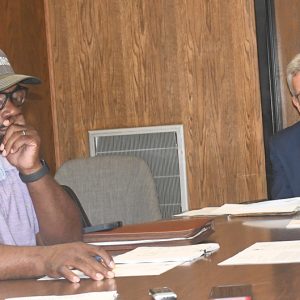
Budget figures are examined during the Sept. 15 meeting.

Yalobusha property owner Terry Nelson was the only citizen to speak in last Friday’s public hearing. Nelson told supervisors he could not afford to pay additional taxes. – Photos by Jack Gurner
By David Howell
Editor
COFFEEVILLE – Yalobusha supervisors approved their budget for the new fiscal year following a public hearing in Coffeeville last Wednesday, Sept. 15.
The new fiscal year starts October 1, and and with no time to spare supervisors approved the new budget that included a 2.59 mill tax increase, bringing the millage rate from 53.76 to 56.35 for the county’s general fund assessment. The budget was approved with a 4-0 vote, as District 3 Supervisor M.H. “Butch” Surrette was absent.
The tax increase comes as the proposed expenditures for the new year are budgeted at just over $3.7 million while the estimated revenue is projected at just over $3.4 million, a $296,475 deficient. An estimated $105,000 increase in the county’s health insurance policy for county workers bumps the total shortfall for the 2010/2011 budget year up to $401,475.
In the new budget, almost 75 percent of the shortfall, or $296,475, will be covered using a portion of the county’s reserve funds, leaving a $96,475 deficient that will be covered by the tax increase.
Compounding the problem for tax payers is a 8.23 mill increase requested by the Water Valley School District and a 3.86 mill increase in the Coffeeville School District.
This means that a property owner will pay an extra $81.16 on property with an assessed value of $75,000 in the Water Valley School District. In the Coffeeville School District, the tax payer will pay an extra $48.38 on property assessed at $75,000.
The county and school tax increase will add $97 to the price of a car tag for a vehicle valued at $30,000 in the Water Valley School District. In Coffeeville, the increase equates to $58 for a $30,000 vehicle, according to figures provided by Chancery Clerk Amy McMinn at the public hearing.
Prior to the vote to adopt the budget, the public hearing started with an explanation of the factors that contributed to the tax increase.
Tax Assessor/Collector Linda Shuffield explained that the county’s assessed value decreased 2.3 percent, which means that each mill assessed will not generate as much money in the coming year.
A second complicating factor cited by Shuffield was a 10 percent decrease in the land use value set by the Mississippi State Tax Commission for large tract acreage in the county.
Shuffield cited an example, calculating the county taxes on a 640 acre tract of land using last year’s assessed value. Last year a taxpayer would pay $2,522 in taxes to the county using the 53.76 mill assessment. This year, with the reduction in the assessed value on that same tract or land, using the same 53.76 mill assessment, the county taxes would be $2,266.
Following the explanation and comments from county officials, one person who attended the meeting commented on the budget.
“This tax increase is going to put people like me out of business,” Terry Nelson told supervisors. “I run a couple of businesses and it is going to put me out,” Nelson continued. “I own land, I got timber. I own several hundred acres.”
“Your taxes should go down on that property,” District One Supervisor Tommy Vaughn responded.
Budget Discussion
Both McMinn and Vaughn relayed the importance of making the smaller tax increase this year instead of making up the entire deficient with the county’s reserve funds.
“We are taking an ample amount out of the reserve fund and we are asking the public for $130,000,” McMinn explained. “Of course it is up to y’all – my recommendation is if y’all don’t want to do a 2.59 millage rate increase, then we are going to put ourselves in a situation in the future we can’t recover from without some significant budget cuts down the road,” McMinn said.
“Otherwise, we need to come up with $130,000 in cuts,” McMinn added, referring to the revenue generated by the 2.59 mill increase.
“Amy just said exactly what needed to be said. But for everybody to understand, this board has been against raising taxes ever since we have been here and for six years I think think we have done an excellent job of keeping it flat,” Vaughn said.
“The easiest thing in the world to do, if you want to get re-elected, is to cover this whole amount this year,” Vaughn continued, referring to using the reserve money to keep from having the tax increase that comes as county elections are scheduled next August.
“The right thing to do is to increase it 2.59 mills and offset it $305,000 out of the reserve fund,” Vaughn added. “This downturn is not a one year deal,” Vaughn stressed, adding that many people are projecting next year will be worse than this year.
Later in the meeting District Five Supervisor Frank “Bubba” Tillman asked if the board could consider lowering the increase by one mill, pointing to almost $1.7 million reserve held by the county.
“At the end of the fiscal year, we will be down to $1.7 million. Is that right, Amy?”Tillman asked.
“That is what I have calculated out,” McMinn answered, adding that there is another $100,000 tied up in a state-funded bridge project that will be added to the county’s reserves.
“You are asking the people up in Water Valley for 10.82 mills,” Tillman continued, referring to the combination of school and county tax levy increase.
“I was counting on maybe if we could get a mill or something like that – to take at least one mill to lower of that 2.59 (increase). That would help the entire county,” Tillman continued.
“We all want to do that and it is hard not to,” Vaughn said. “When you look at this increase, you are not talking about but $25 for the county, the rest of it is for the school and we don’t have any control over it,” Vaughn added. His comment referred to an example cited earlier that the 2.59 mill increase will result in a $25 tax increase for property assessed at $100,000.
Capital Improvement Fund
Supervisors did leave $100,000 budgeted for a capital improvement fund after initially agreeing not to levy taxes for the fund during a budget meeting held August 27.
“I thought we had discussed taking that one out,” Tillman said, as McMinn went through each line item in the budget.
“We discussed it, but I can’t recall,” Vaughn said.
“I thought we took it out?” Tillman asked.
“There is no increase there or decrease there,” McMinn explained. “It is that not our capital improvement fund?” she asked.
“Yes, it is just there,” Vaughn responded.
“You have money sitting there in case we need to do something,” McMinn ex-plained.
“Just anything we need to use it for, as far as our buildings tearing up or something. We got something to fix it with,” Vaughn replied.