Beat/Unit Discussion: Round 2
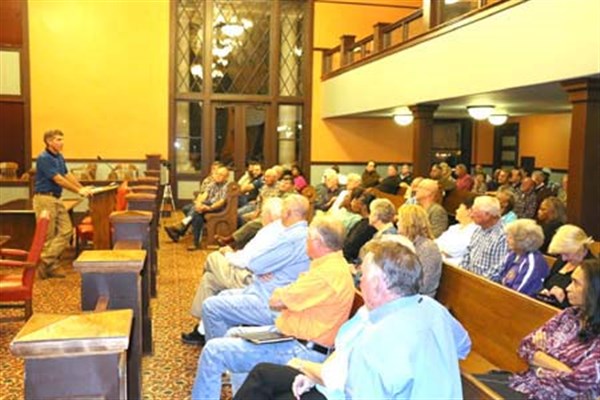
County Engineer Karl Grubb was among speakers in the October 20 meeting on the beat and unit system. He explained that 42 of the county’s 85 bridges have been replaced in the last two decades.
Editor
WATER VALLEY – A second round of input on the beat and unit systems of government came during a meeting held at the Water Valley courthouse on Oct. 20 with supporters of each system addressing a packed courtroom. A similar meeting was held in Coffeeville on Oct. 6 as the issue will be on Tuesday’s ballot with a majority of voters determining the outcome.
Board of Supervisors President Tommy Vaughn took the podium first, presenting his opinion in favor of the beat system.
“We’ve all got the same thing in mind, what’s the best way to run our county,” Vaughn said in his opening comments as he welcomed the crowd. “I can’t tell you for a 100 percent either one is better, both of them have merit,” Vaughn said, referring to the unit and beat system.
But Vaughn said his experience serving a dozen years as supervisor – as well as the opinion from other current and previous supervisors in the county based on their experience– all indicate the beat system is a better fit for Yalobusha County.
“Our county is too small for a unit system. We have fifty-nine million dollars in assessed value in our county.”
Vaughn said the two new jobs would create another layer of bureaucracy at a cost of as much as $150,000 annually, “it’s an expense we cannot afford.”
Vaughn also combated claims from proponents of the unit system, including cutting the manpower through attrition.
“We already cut back,” Vaughn said, referring to the cuts made as the county battled through the recession.
Vaughn also countered other claims made in newspaper advertising, including extra manpower for equipment maintenance; picking up trash with extra manpower; using larger dump trucks for daily operations, and creating additional checks and balances.
Vaughn’s answers: if manpower is cut, how will extra manpower be used for gar-bage pickup and equipment maintenance; larger dump trucks would tear up county roads, and the county has existing checks and balances.
Vaughn added the job as supervisor requires common sense and dedication to the county, requiring long hours at times.
“Here is the newspaper telling us we are criminals. You talking about knocking the wind out of you, I spent 30 hours straight when Hurricane Rita came through here. I didn’t see anybody patting me on the back, and I wasn’t looking for a pat on my back. But here in the newspaper we are called criminals,” Vaughn continued.
“The next time you see a supervisor on the street, just for the heck of it say ‘thank you.’ They may pass out.”
Frank Brooks Follows Vaughn
Unit supporter Frank Brooks followed Vaughn, focusing on work performed on private property using tax dollars. But first he explained the process of obtaining the needed signatures to bring the issue to vote.
“Tommy talked about the articles in the paper that made him feel bad, I can tell you what made us feel bad,” Brooks told the crowd. He said some doors were closed as they went house to house seeking signatures.
“One man said get off of my property, my supervisor says if I even talk to you I am going to lose my job. That happened,” Brooks said, adding there were similar incidents during the signature process.
“A lie doesn’t become truth, wrong doesn’t become right, evil doesn’t become good, just because it is accepted by the majority,” Brooks then said as he shifted to his primary topic for the night.
“We have hired four new supervisors, all of them fine young men… How long will it be under the system you are working under before they break the oath of office?” Brooks asked as he held up the words each supervisor will recite as they take office in January.
“If we put them back in the system we have today, what is going to happen?” Brooks continued. “How many people in here are going to call them and want them to do something for you personally. If you take something that is not yours, if you give it away, you just violated two laws, God’s law and man’s law,” Brooks explained. “Is that what you want to do to four young men, put them in a system so they can be a failure. Every supervisor has the right to help people that need help, they just don’t have the right to do it with funds that are not theirs,” Brooks continued.
Brooks said he had visited with numerous supervisors in north Mississippi, asking them the same question.
“What percent of the work that you and your men do is on private property?” Brooks explained.
“It went from 20 percent the lowest, to 70 percent the highest,” Brooks said, referring to answers he received from neighboring supervisors.
“I ask all of the supervisors here, where do you fit in?” Brooks continued. “The question is, do we want to perpetuate a lie that it is okay to violate the law continually?”
Questions And Comments
Following Brooks’ comments the meeting moderator, Mississippi State University Extension Service Government Training Specialist Sumner Davis opened up the question and comment portion of the meeting. “Whether you go from a beat to a unit system, it all depends on who is elected,” Davis explained, adding there are examples of each system operating efficiently across the state. Comments from the public included:
• Former supervisor Bailey Walker noted the small population of the county, adding the operating revenue is low.
• William Shelton questioned what would happen if the county administrator disagrees with the general ideas of supervisors. Davis answered, explaining the county administrator would likely not stay employed long because ultimately he works for a majority of the board of supervisors.
Shelton also questioned if the county administrator and road manager would change with each new board every four years. Davis said the two positions could change, because the road manager and county administrator work for the will and pleasure of the board.
• Kagan Coughlin questioned the timeline for filling the two new positions if the unit system passes. Davis answered, explaining they would need to be filled as soon as possible. He also said if a vacancy comes down the road, statutory requirements dictate the board fill the position as soon as possible.
• County engineer Karl Grubb explained the county would continue to receive the same amount of road and bridge money allocated from the state under either system. Grubb said in the last 20 years, the county has replaced 42 of the 85 bridges on county roads. Grubb also said there are 11 bridges posted with low weight limits because of deficiencies. He also said there are five bridges in the county that need to be replaced. Grubb also said, based on his experience working in multiple counties, the tax base is the biggest contributing factor for better roads and bridges.
• John Beshears reported he has attended both meetings on the issue and has not received facts regarding monetary savings under the unit system.
“All I have heard them talk about is how corrupt our supervisors are,” Beshears said. He also said he had requested a culvert in Beat 5, but was rejected because the washed area was determined not to be a result of runoff from road drainage. Beshears added, that if illegal work was being done, he would have received a culvert.
• Mickey Howley said the unit system would take the burden of daily road work away from the supervisors, allowing more time to manage the county’s affairs including economic development. Howley said this would also attract a wider range of candidates to seek the office, including women and professionals. Howley also said the land values per acre in counties instituting the unit system since 1988 is higher than counties that kept the beat system. Howley acknowledged that the size of the county is a factor in the statistics.
“But it is not who we are now, but what we aspire to be,” Howley added.
• Larry Bell said he signed the petition, but would vote against the unit system. He noted the people in Lafayette County would like to change back to the beat system. He also said the road management doesn’t appear to be better in the neighboring county. “If it is not broke, don’t fix it,” Bell said.
• Longtime Water Valley businessman Tommy White said his family had never been asked to do anything underhanded by supervisors while selling petroleum products to the county. He also said available information did not show enough savings to warrant the switch to the Unit System.
• Gene Smith reported he checked on the salaries of road managers and county administrators. After researching the issue, he said the county administrator’s salary is comparable to the Chancery Clerk’s position, while the road manager’s salary was comparable to the supervisors’ salary.
• T.G. Baker said his research indicated manpower on the road crews could be cut by 25 percent as the workers would be more efficient. He also said county equipment and fuel cost could be reduced.
More Input From Davis
Earlier in the meeting, Davis explained the origin of the Unit System, explaining an FBI investigation into county corruption in the late 1980s was the driving force.
“It was widespread in the state, generally revolving around the purchasing through supervisors’ districts,” Davis explained. He said the fallout from the operation landed a number of supervisors in jail and required each county to vote on the unit system. Additionally, Davis explained all counties were required to institute a central purchasing, establishing a purchasing clerk, receiving clerk and inventory control clerk.
“Yalobusha County has centralized purchasing today, it doesn’t change, that is already in place,” Davis added
Unit Information
Other information about the unit system provided at the meeting included:
• Supervisors’ districts would no longer serve as road districts and the construction and maintenance of roads and bridges would be determined on a county-wide basis by the Board of Supervisors.
• Any real and personal property of any road district becomes the property of the countywide system of road administration.
• No supervisor can serve as the road manager.
• Two new jobs will be created, the county road manager and county administrator.
• The road manager shall be educated or experienced in the construction and maintenance of highways, bridges and other facets of county highway responsibilities.
• The road manager, under the policies of the supervisors, administers the county road work, carrying out the general policies of the board.
• The road manager employs personnel and has jurisdiction over their assignments.
• The county administrator functions within the courthouse and runs the day-to-day operation of personnel, but not the personnel of the sheriff’s department, road department and employees of countywide elected officials (tax assessor/collector, circuit clerk, chancery clerk, sheriff, etc.).
• The county administrator is delegated authority through state legislature and implements the policies the Board of Supervisors set.
• The county administrator is not required to hold a college degree, but must be knowledgeable in the areas of work projection, budget planning, accounting, purchasing, cost control and personnel management.
Beat Information
• Supervisors independently manage roads and bridges in their beats.
• County revenues for roads and bridges are usually divided equally or as determined by the board, and distributed to each road and bridge fund. The supervisor then spends the funds as he sees fit, within the limitations of Mississippi Code and with the approval of the entire board.
• Each supervisor usually maintains a barn or storage facility where his beat’s road equipment can be stored.
• Each supervisor maintains a road crew and may hire a foreman to oversee the work of the road crew.
• Supervisors can hire a county administrator if they desire.