Latest MDEQ Testing Indicates No Health Threat
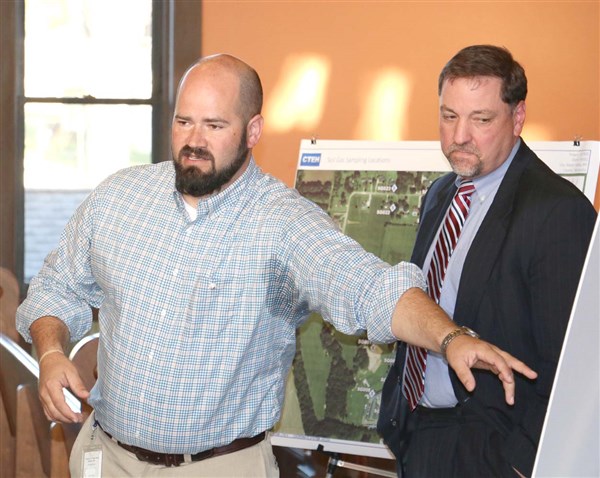
MDEQ remediation specialist William McKercher and executive director Gary Rikard discussed the test results at last week’s meeting.
Latest MDEQ Testing Indicates No Health Threat
By David Howell
Editor
WATER VALLEY – Speaking at a public meeting last Tuesday, Mississippi Depart-ment of Environmental Quality (MDEQ) officials reported there is no immediate health threat from the decades-old chemical release at the former Colt Industries/Holley Carburetor facility.
Citing the results from February testing to identify potential vapor intrusion from the trichloroethylene (TCE) that was initially detected at the industrial site in 1988, MDEQ Executive Director Gary Rikard told a group of 30-plus attendees that the results indicate the levels do not pose a risk to human health. Rikard and MDEQ remedial director William McKercher shared time at the podium fielding questions and providing updated information in the second meeting the agency has hosted in the second floor courtroom of the Water Valley courthouse.
McKercher said another round of testing will be conducted in the summer months, when there is less moisture in the soil, and a 10-year remediation plan will be implemented to reduce the levels of TCE in the soil and water to a level that is non-detectable or below the agency’s screening level.
Since the release of TCE, commonly used as an industrial degreaser, the chemical has crept toward O’Tuckolofa Creek in an area described a plume that spans an area north of the industrial site that includes an estimated 28 residences and 11 commercial buildings on portions of South Main Street, Frostland Drive and Champion Circle. The contaminated area includes the county-owned hospital and nursing home and Depart-ment of Health building on South Main.
Scrutiny at the site resurfaced in February after MDEQ obtained an order from the Mississippi Commission of Environ-mental Quality on February 5 requiring EnPro Industries to formulate a remediation plan to address vapor intrusion and ground water contamination. EnPro Industries required liability for the site in 2002 following a string of ownership changes.
Rikard also explained the recent scrutiny stems from new guidance issued last summer from the Environ-mental Protection Agency (EPA) regarding vapor intrusion, or the process where vapors from underground solvents travel upward through the soil. The potential problem then would be TCE entering a home or residence as a vapor and be inhaled. TCE is a known carcinogen and causes toxic effects to the kidneys, central nervous system, liver, immune system, male reproductive system and a developing fetus.
But McKercher said the soil in Mississippi makes it very difficult for vapors to surface. He also said the guidance issued to determine the screening level for dangerous levels of TCE during testing is very conservative.
“Yet, everything that we tested was a magnitude of 10 below that?” Amy Chrest-man asked, referring to earlier numbers cited at the meeting showing the actual amount of TCE detected in the soil during the February testing was much lower than the screening level.
“Right,” McKercher answered.
“So what is the big deal?” Chrestman, who owns a house on Champion Circle in the plume, asked.
“The big deal before is we didn’t know, so we wanted to make sure,” Rikard answered. The MDEQ executive added that now that vapor is potentially an issue, his agency wants to eliminate the source, referring to the 10-year remediation plan.
McKercher also explained that the EPA guidance issued last summer gives MDEQ an opportunity to require EnPro to address the issue.
“We went to EnPro and said, ‘we need you to do this to make sure vapor isn’t an issue,’” McKercher explained. “Up until this point, we didn’t have a way for companies to formally require the companies to evaluate inhalation. We are doing this at sites all across the state, we have been doing it since last fall.”
“We just wanted to make sure. That is why we made a big deal out of it. We didn’t think EnPro was reacting as quickly as they should have,” Rikard also said.
Property Values
Property values for the homes and buildings in the affected area was also a topic at the meeting, although Rikard emphasized the role of his agency is to protect human health and the environment.
“There absolutely is a problem down there,” District 3 Supervisor and real estate broker Lee McMinn emphasized, citing the impact on property sales in the area has already surfaced on property he has listed.
Responding to questions from both McMinn and Chrestman about real estate values, Rikard said he could not answer how property values would be affected.
“I don’t know the answer, if that is an issue of concern, I would talk to an attorney about that,” Rikard said. “The last thing I wanted to do is make a bigger deal out of this where it impacted property values. That was certainly not my goal. But by the same token, we didn’t know the answer of whether there was a problem or not. God forbid there would have been (a problem) and we didn’t do anything,” Rikard continued.
McMinn also asked if a more aggressive plan could reduce the level of impact faster than the 10-year plan currently proposed.
“It takes time,” McKerc-her answered, adding that expediting the plan is not feasible because of the lengthy process. “For us, 10 years was a best case scenario.”
Other questions at the meeting included:
A former plant employee, Patricia Kachelein said she had worked at the plant when TCE was first discovered in the water system at the plant, which she drank. She also said the chemical was used even prior to her start date at the plant in 1979.
“I have been told that once that chemical is in you, it doesn’t go away,” Kachelein said.
“I am not a toxicologist and I don’t know the answer to that,” Rikard replied, adding that TCE was commonly used as a cleaner/degreaser.
“Obviously certain protections should have been put in place,” Rikard added.
They disconnected from the water in 1988. I started in 1979. They knew about this chemical before I started,” Kachelein continued.
“They knew it had been released into the environment or they knew they were using the chemical?” Rikard asked.
“They knew that the chemical was bad. OSHA told us about it in 1988,” Kachelein continued. “Once it is in the ground… it is always there.”
“TCE does naturally degrade over time,” McKercher explained.
“But not if you are still using it, right?” Kachelein asked.
“The plant (BorgWarner) right now is actively still using TCE. It is part of their process,” McKercher explained, adding that there are stringent handling requirements, which are monitored by OSHA. “To our knowledge – since this issue was identified in 1988 there have been steps taken at the plant, inspections since then have not identified releases that we are aware of.”
McKercher also said the soil was excavated at the industrial site and cooked to remove the TCE in the early 1990s. He said the plant was also switched to the city’s drinking water after the 1988 discovery of the contaminant.
Responding to a question from Clay Ashford, McKercher said the plume could move 18 to 24 inches per year.
McKercher also explained the groundwater is tested by EnPro twice per year, in March in September, and the latest results are available.
Actions Taken in the Past
The MDEQ officials also revisited past steps taken at the site. This included massive the soil excavations at the site, where the soil was cooked at the site to get rid of TCE. Another step taken by EnPro was the installation of two remediation systems, called groundwater extraction wells, to keep the TCE from reaching O’Tuckolofa Creek. The intent was to keep someone swimming or wading in the creek to have direct contact with TCE. “While that system was in operation, it would keep everything from coming in there,” McKercher explained. Not mentioned at the meeting, but cited in an earlier meeting was the use of the two groundwater extraction wells was stopped in 2008 by EnPro.
However, two years before the groundwater extraction wells were cut off, McKercher said EnPro injected chemicals into the water in a field across from the industrial site to see if they would reduce the level of TCE in the ground water in what was described as a pilot program. Initially the program worked, but the levels of TCE returned to the groundwater later.
“It showed they needed a significant amount more of that product than what they had,” McKercher added, referring to the chemical injected into the groundwater.
Looking Ahead
The MDEQ officials reported a work plan was due by EnPro is due by the end of May, which will outline the 10-year remediation plan. Also ongoing information will be posted to the MDEQ’s website to keep the public informed about testing data.
County officials also met in executive session during the “first Monday” board meeting to discuss possible litigation against EnPro in regards to the county-owned property that includes the hospital and nursing home. The meeting marked the fourth discussion on the matter. Board President Cayce Washington told the Herald the public would be informed as soon as a decision is made by the board.
Yalobusha Health Services Administrator Terry Varner reported construction on a daycare currently under construction on Frostland Drive has been halted after almost $200,000 has been spent on the half-million dollar project. The daycare has long been identified by Varner to provide childcare services in the community.