Supervisors Weigh Options To Combat Litter Problem
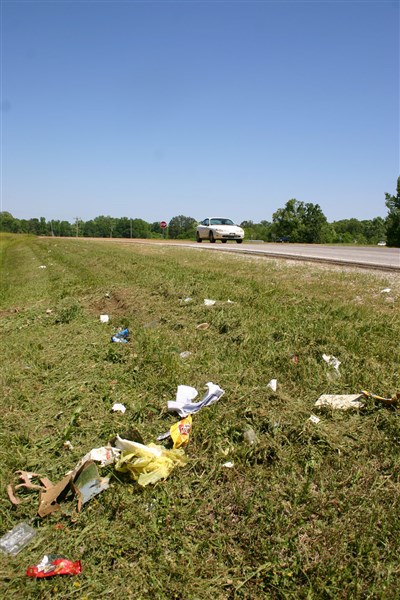
County supervisors are discussing options to combat litter along roads.
By David Howell
Editor
COFFEEVILLE – With spring and grass cutting around the corner, litter scattered up and down roadsides continues to garner attention from county supervisors as they seek solutions to combat this problem. Flooded creeks and ditches in recent weeks washed litter higher along road ditches, making it even more visible as the dormant winter grass comes back to life.
In November supervisors launched an anti-litter campaign, Yalobusha Clean, to attack the longstanding litter problem in the county with a goal to promote the campaign with social and print media, road signs and other marketing material. Last month the campaign’s Facebook page, also named Yalobusha Clean, was created to recognize groups and individuals in the county who work to clean up roadside litter and illegal dump sites in the county.
At Monday’s supervisor meeting in Coffeeville, the discussion centered on utilizing inmate labor to pick up litter, another potential tool to attack the unsightly rights-of-way along county roads and state highways. Prior to 2015 much of roadside litter pickup across the state came from state inmate labor, as counties partnered with the Mississippi Department of Corrections (MDOC) to combat this problem.
A public corruption scandal in MDOC in 2015 prompted the agency to terminate the Joint State County Work Program and remove state inmates from county jails as a cost-cutting measure.
Speaking at Monday’s meeting, Sheriff Lance Humphreys explained that some counties still utilize state inmates housed at local jails to pick up trash. But the sheriff noted that prior to the change in MDOC policy in 2015, counties were paid $20 per day to house the state prisoners. Now the counties must incur the cost of housing the state inmates.
One option, Humphreys told supervisors is to utilize deferred sentencing in circuit court, which basically allows an inmate to plead guilty and remain in the county and work as a trusty instead of immediately being sentenced and shipped off to a state prison. The sheriff cited Calhoun County as an example, explaining inmates there are utilized to pick up trash and often work a year or two before they are sentenced. He added that the time served in the county jail is credited toward their sentence.
“I requested to the District Attorney’s office, that if we can do it that way, let’s do it. I haven’t heard back yet,” Humphreys said about using deferred sentencing in Yalobusha County.
Another potential option, which generated the most discussion in Monday’s meeting, is utilizing offenders in the county’s justice court system to pick up trash and perform other community service. In 2010 supervisors adopted a county inmate work program as a sentencing option for the county’s two justice court judges. However the program has not been utilized as the local judges have cited problems with it.
District 1 Justice Court Judge Janet Caulder requested to be on the agenda at Monday’s Board of Supervisor meeting and asked for an update about an earlier proposal she submitted to county officials to revise the 2010 work program. Among her recommendations is to allow non-incarcerated offenders to work under the supervision of county or state employees for a designated length of time in lieu of paying fines owed to the court.
Her proposal differs from the 2010 inmate county work program, which requires offenders to be incarcerated and under the supervision of the sheriff if they perform community service as a sentencing option.
At Monday’s meeting Caulder also explained that offenders in justice court under her jurisdiction have committed misdemeanors and likely aren’t incarcerated. She also explained that justice court cannot force offenders to participate in a work program, even if they owe back fines. Instead, she explained, they must voluntarily agree to work to pay off a fine.
“Circuit judges would have a lot more leeway to use this. There is very little in the law as far as work programs go,” Caulder added. “I reached out to other counties to ask them for their work program. The ones that I heard back from said ‘we don’t have one, when you get yours done let us know,’” she also explained about utilizing justice court offenders for community service.
Details of the Program
“Correct me if I am wrong, but you weren’t really thinking they would report to the sheriff’s office?” Board President Cayce Washington asked as details about the program were hashed out.
“No, it would be a voluntary thing to get their fine handled,” Caulder answered.
“Who would see to it that John Doe works during the hours required by you to get that credit?” Crow asked.
“As far as the roadsides, that would fall on your road districts,” Caulder answered, citing one example of a county department, state agency or non-profit organization to which the offender would be assigned.
“The only worry I would have is the correspondence between the judge and me to work out the logistics of all that to happen,” District 3 Supervisor Lee McMinn asked. “I have to tell the judge what the needs are, then I need to make sure they pick the trash up. If they use my provided orange bag, then I will know how much trash got picked up,” McMinn added, noting that it will require extra work for supervisors and the judges.
“They have to volunteer to participate, I can’t force them,” Caulder said.
“Why don’t I get the (2010) work program out and tweak it and run it by Judge Caulder and Judge (Steve) Riley and if we are all on board on this we will see how we can get this thing going,” Board Attorney John Crow said, answering Caulder’s initial question about revising the current county work program for justice court offenders.