Roundabout Likely Best Option For Bypass Intersection
PROTECTED CONTENT
If you’re a current subscriber, log in below. If you would like to subscribe, please click the subscribe tab above.
Username and Password Help
Please enter your email and we will send you a password reset link.
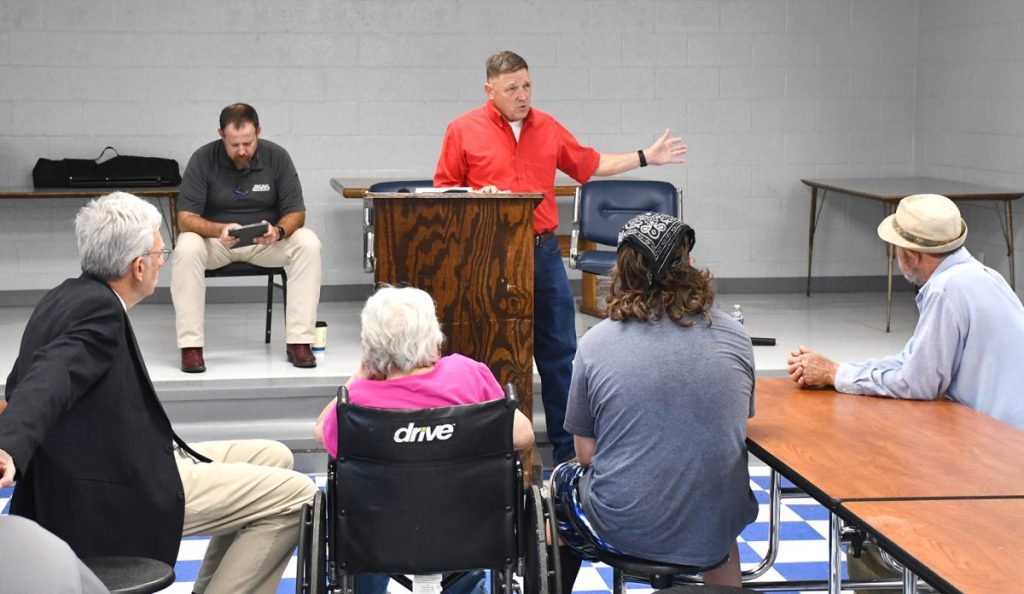
Northern District Transportation Commissioner John Caldwell addresses community concerns during a public safety meeting held July 17 at Water Valley High School.
WATER VALLEY – The number of crashes at the intersections on the Highway 7 bypass brought local officials, Northern District Transportation Commissioner John Caldwell and concerned residents together on July 17 for a public meeting at Water Valley High School.
The primary focus is the Wise Street and Highway 7 intersection—a crossroads that has triggered frustration for decades, marked by wrecks and near-misses that many in the community know all too well.
Water Valley Police Chief Jason Mangrum opened the meeting with data about the intersection. In the last five years, the Hwy. 7 and Wise Street intersection has been the site of 20 crashes, including one fatality this year, one in 2019, and multiple incidents requiring hospitalization.
“In 2025, we’ve already had four wrecks there,” Mangrum told the crowd. “One fatal, one with a person transported, and two with either no injuries or minor ones.” The numbers have been steady for years: three crashes in 2021, six in 2022, four in 2023, and three in 2024. Most of the accidents happen during daylight hours.
“We just note if they were transported to the hospital or not transported,” Mangrum explained. “We didn’t determine the severity of injury, that is not our area of expertise.”
Despite rumble strips, flashing lights, and other warning signs, the intersection remains dangerous. Residents at the meeting shared personal stories of near misses, or worse—wrecks they’ve witnessed firsthand. One attendee, Terry Allen, summed up what many were thinking: “Something is wrong.”
Northern District Transportation Commissioner John Caldwell agreed, but emphasized that MDOT’s engineers haven’t identified a design flaw. “That is why we had traffic division look at it,” he said. “They are not seeing the geometric reason for the wrecks people are having. We have to figure out a way how to slow the people down and have them obey the stop sign.”
Caldwell pointed to what he believes is the root problem: driver behavior. “People intentionally run stop signs and I don’t know what to do about that,” he said. “We can’t design for every drunk driver, texting driver, and so. We do look at causes and effects.”
Local resident Lee McMinn questioned whether most of the drivers involved were from out of town. “In my mind, most of these people who are flying through these stop signs are maybe not from around here,” McMinn said. “But the statistics that I heard at the beginning of the meeting are different from that.”
Mangrum had already made that clear. Each year, a majority of the drivers involved in crashes at the intersection have been from Water Valley—three in 2025, two in 2024, three in 2023, four in 2022, and three in 2021.
Caldwell agreed the problem isn’t just unfamiliarity. “There are people who know good and well about that stop sign and run it anyway,” he told McMinn. “And what we can do—the first thing I noticed when driving it today—we have a 45 MPH speed limit sign 200 feet from the intersection. I guess we could slow it down to 35 MPH when we get that close.”
Multiple attendees, including Eddie Foster, called for a lower posted speed limit approaching the intersection. Caldwell responded, “I think some of what we need to do is look at our speeds. What are the speed zones that we have, can we lower the speeds. We still have to look at enforcement. If they disregard the stop sign, more than likely they will disregard the speed.”
The long-term fix may be a roundabout, a solution Caldwell said has proven effective in other parts of the state. “The roundabouts do work, it forces drivers to slow down,” he said. “I think you have a real good case for a roundabout. But it is not going to happen very quickly, because MDOT doesn’t do anything quickly.”
He added that the Hwy. 7/9 roundabout in Lafayette County took years to approve and fund, even though that intersection has higher traffic counts and more fatal crashes than Water Valley’s.
“I can say, yes, I can get you a roundabout,” Caldwell told the audience. “But it might be eight years.”
Money Matters
The delay is due in part to limited funding and long project backlogs. “If we only have the money to do 10, are you in the top 10?” Caldwell asked rhetorically. “That is why money matters.”
Caldwell explained that while MDOT’s budget has technically increased, it has not kept pace with inflation or construction costs. “We have more money, but we don’t have the spending power they did when the Eisenhower Interstate System was developed,” he said. “If we stayed up with inflation, we should be at $1.9 to $2 billion dollars.”
He said MDOT operated on a $1.33 billion budget about 12 years ago and currently has a budget of around $1.44 billion—a modest increase in raw dollars that doesn’t reflect rising costs. “There have been some dips, in the Covid year we were down to $1.00 billion,” he noted.
Fuel tax increases approved by the Legislature will eventually bring in about $150 million per year, including a three-cent-per-gallon increase that took effect July 1. Two more increases are scheduled—another three cent increase in 2026 and another in 2027 for a total of nine cents.
“The total amount that MDOT receives from that nine cents a gallon is about $150 million a year,” Caldwell said. “I told you our budget should be around $2 billion, so $150 million doesn’t give us even 10 percent increase.”
Caldwell expressed appreciation that state lawmakers adopted the fuel tax increase.
“Hallelujah we got it passed, but it is not earth-shattering, game-changing money. It is survival money,” Caldwell explained.
Even so, Caldwell said he is committed to helping Water Valley’s case move forward. “Nobody at MDOT, past, present or future, are just shrugging their shoulders,” he said. “We are all trying to figure out a way to make it safer.”
Mayor Tommy Reynolds also attended the meeting and reiterated his support for four-laning Highway 7 between Oxford and Grenada. As a former state legislator, Reynolds said funding is in place to widen the road from Highway 6 to the Hwy. 7/9 split, but more will be needed to bring it all the way south to Water Valley.
“I think a four-lane would greatly benefit us,” Reynolds said.
For now, community members like Libby Kuchta are asking what can be done in the meantime.
“What we are hearing is we may or may not get a roundabout, but if we do it will take a while,” Kuchta said. “What else can we do to make it safer until then?”
After the meeting Kuchta launched a Facebook page, My Scary Incident on the Water Valley Bypass. The page will allow people to document their close calls and scary incidents at the intersections on the Water Valley bypass.