Engineer: System Underfunded For Decades
PROTECTED CONTENT
If you’re a current subscriber, log in below. If you would like to subscribe, please click the subscribe tab above.
Username and Password Help
Please enter your email and we will send you a password reset link.
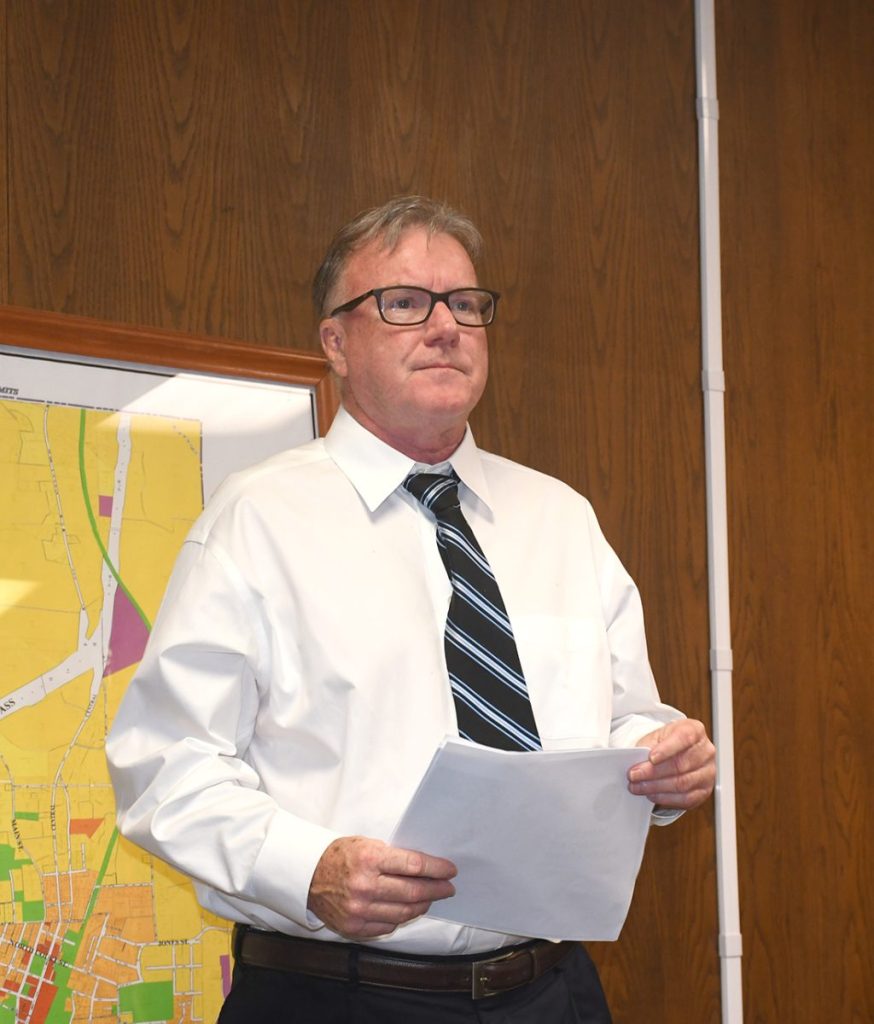 WATER VALLEY – The newly appointed Water Valley Electric Commissioners were sworn in Monday night during a packed public meeting at City Hall, marking the beginning of a new chapter for the city’s electric department. Although the commissioners won’t officially assume their legal duties until August 1, the gathering also served as an in-depth work session to outline the scale of the challenges ahead.
The standing-room-only meeting included presentations from the Tennessee Valley Authority (TVA) and Atwell and Gent Engineers, a consulting firm hired to assess the city’s electric infrastructure and help guide its renewal.
Jeff Atwell, principal engineer with Atwell and Gent, delivered the most sobering message of the night.
“The point of this is Water Valley has historically underinvested in upgrades and replacement of equipment,” Atwell told the crowd.
“This is not a five-year problem, or a 10-year problem. This is a long, long issue that has been in the making. If you have an automobile and you don’t maintain it, you can do that for quite a bit of a time. Then you hit the tipping point and things start breaking. It gets more expensive and harder to keep running, and we are getting to that point.”
Presiding over the meeting was Commissioner Brandon Presley, who emphasized the importance of transparency and public engagement.
“There are so many issues to cover,” Presley said. “We want to get off on the right foot by inviting you, the customers, to be here tonight.”
Representatives from TVA, including Amy Tate and Tyler Wilson, provided insight into the federal agency’s mission and regulatory role.
“We don’t have stockholders, we don’t make anybody rich,” Tate said. “The money that you pay on your utility bills goes back into the system, goes back into our communities.”
Tate highlighted TVA’s emphasis on public power, economic development, and community investment.
“Affordable, reliable power is high up on the list for companies during site selection,” she said about recruiting new industries and businesses to the city. “You will get cut from the process real quick if you can’t provide it.”
Wilson, TVA’s Manager of Regulatory Assurance and Compliance, outlined five core regulatory objectives, including ensuring that revenue collected from electric customers is reinvested in the electric system.
“We want to make sure that when you pay your electric bill that it goes to electric system purposes and it is not being siphoned off to some other entity within the city,” Wilson explained.
Wilson also addressed shared assets, such as City Hall, which houses both municipal offices and the electric department.
“We are making sure that there is fair joint use,” he said. “That the electric (department) is paying its fair share, but it is not subsidizing other departments.”
When Presley questioned if TVA micromanages local decisions, Wilson said that local decision makers have broad discretion.
Wilson explained that rules and regulations from TVA set the regulatory framework, and then decision makers at the local level decide what is best within those guidelines.
“Those guard rails are pretty wide before it violates some (TVA) term of contract,” Presley countered. Then, citing an example, Presley said during his 16 years of service as Northern District Public Service Commissioner in Mississippi, he only saw TVA take legal action against one power company in the state.
Critical Infrastructure Concerns
Atwell presented a detailed breakdown of the city’s aging infrastructure and identified several immediate concerns. Chief among them: Water Valley’s electric system relies on a single substation with multiple single points of failure.
“Any engineer that works in the electric utility business, when you talk a single point of failure, particularly at the source of power, is very concerned,” Atwell said.
Atwell also noted that some of the substation equipment is more than 70 years old. Next he explained that three feeder circuits branch out from the station—two running south toward the hospital and Solero, and one serving an estimated remaining 90 percent of the city.
“It has been that way forever… that is real problematic,” Atwell said about the one segment that serves the bulk of the city.
The next problem cited by Atwell is that a portion of the city’s grid, including the west side of Main Street and areas west such as Water Valley High School, still operates on a 4kV system—an outdated standard no longer in use by most municipalities.
“If I was going to take a guess, the original 1938 electric system [in Water Valley] was the 4kV system,” Atwell said. “A lot of it that is still in place today serves downtown and areas across the bypass. It is very, very old.”
Mayor Tommy Reynolds quipped that the system “should be a lead exhibit in a museum.”
Line Loss and Missed Revenue
Atwell also flagged line loss, or electricity that the grid loses for various reasons, as a major concern. The city loses six percent of the electricity it purchases from TVA—well above the industry average of four percent. The outdated 4kV lines are a big part of the problem, with Atwell noting that line loss is nine times greater on the old lines than on newer ones.
“That has got to be a priority, day one,” Presley said. “If we were able to get (line loss) down from six to three percent, that adds back $147,000 in revenue into the electric system.”
Presley noted that 20 percent of the city’s electric meters still haven’t been upgraded to advanced metering infrastructure, a project initiated in 2022 that will also help with line loss. He also pointed to the importance of tree trimming and ongoing right-of-way clearing to prevent outages and decrease line loss.
Funding Gaps and Missed Deadlines
Another major concern is the unfinished work on two backup substation transformers near Solero and the hospital. Funded in part by a $387,000 Delta Regional Authority (DRA) grant, the transformers are not yet operational.
“Those two transformers that are there now are not connected,” Presley said. “One is in place but not connected. The other—no dirt, no transformer. They are absolutely benefiting the city nothing right now as far as backup power.”
Presley said that the deadline from DRA to complete the project is October 31. Meanwhile, the city has also applied for an additional $2 million DRA grant to upgrade part of the 4kV system.
“But we can’t with good conscience go in and ask for $2 million when we haven’t completed the project with the $387,000 from DRA,” he said.
Presley also told the crowd that he believes General Manager Crystal Floyd has a plan to meet the October deadline.
Final Questions
“Do we have an adequately trained staff to address all of these issues that were brought up tonight?” Commissioner Hawkins asked.
Superintendent Brandon Richardson explained that linemen complete a five-year apprenticeship, with a 10-year timeline to become journeyman-level.
“And a lot of it is learning on the job—most of it is,” Richardson said. “But we have always had trouble.
I have been here 19 years, and I know we have given multiple people the same choices and opportunities I received. They won’t even complete the schooling and quit.”
Also provided at the meeting was the department pay scale:
• Electric department manager – $104,083 annually
• Superintendent – $91,520
• Foreman – $76,960
• Other employees – $17 to $25 per hour
A Path Forward
Commissioners and engineers outlined immediate priorities:
• Complete construction of the backup substation transformers
• Begin right-of-way clearing, including a $327,000 tree trimming project that was awarded to an Alabama company earlier this month; and 13 miles of in-house line work
• Prepare for a new or renovated substation, leveraging anticipated federal funding already awarded to the city
• Accelerate replacement of hazardous poles and aging equipment
As the city’s new electric commission prepares to formally assume control, Presley made it clear that the road ahead will demand difficult decisions—and full accountability.
“Our job as the commission is to be honest with you,” he told the crowd.