Aldermen Tackle Wide-Ranging Agenda, From Job Descriptions To Speed Bumps
PROTECTED CONTENT
If you’re a current subscriber, log in below. If you would like to subscribe, please click the subscribe tab above.
Username and Password Help
Please enter your email and we will send you a password reset link.
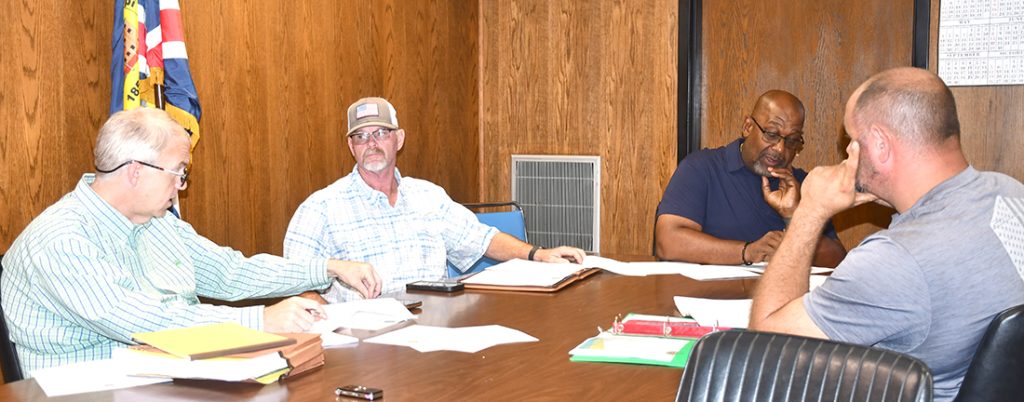
Water Valley Electric Commissioners have met four times since taking office on August 1, and Commission Chairman Brandon Presley reports to the Water Valley Board of Aldermen monthly. Shown at the August 15 meeting are (from left) Commissioners Presley, Terry Allen Jr. and Ray Hawkins with superintendent Brandon Richardson. (Not pictured, but attending meeting are also commissioners Dr. Vickie Person and Dr. Barry Weeks.
WATER VALLEY – The new Water Valley Board of Aldermen tackled a lengthy agenda in their monthly on August 5, a two-and-a-half-hour session that touched on everything from city-wide job descriptions and department leadership to electric system upgrades and speed bumps. Several of the agenda items pointed to matters that could shape the board’s work in the coming months, including Alderman Grant Thompson’s call for written job descriptions for all city employees and his request to consider adding a public works director.
Thompson said job descriptions are a basic tool for accountability and fair management across departments. His motion, which aldermen adopted unanimously, requires department heads to write descriptions for every position and submit them to the mayor, board and city attorney. There was no deadline set for completion of defining the duties.
“I think that it is safe to say that the electric department is not the only department that is behind on the times,” Thompson prefaced his remarks. “I know we can’t get everything fixed in one day, but we can move in the right direction.”
Thompson explained that some departments currently have job descriptions, while others do not. And when the idea was floated years ago, it was brushed aside.
“I spoke with previous aldermen who said they tried to get that passed before and it was kind of a laughing matter, like ‘why do we need to write down a job description for someone who is riding on the back of a fire truck… we know what they do,’” Thompson said.
“The answer is, we have to know what everybody is doing in the city so when positions come open, we know how to advertise to fill these positions,” he continued.
In reading his motion, Thompson said the policy is about accountability and protection for both employees and the city.
“Accurate, up-to-date job descriptions is essential for effective management as they provide clarity for employees regarding their roles and expectations,” he read. “They also assist department heads and supervisors in evaluating performance fairly and consistently and help avoid misunderstandings or duplication of duties and serve as a vital tool during hiring, training and the disciplinary process. Furthermore job descriptions promote transparency to protect the city from legal and personnel issues and ensure that taxpayer funds are used efficiently. Implementing this policy will strengthen accountability and professionalism across all departments in service to the city of Water Valley.”
Thompson also had a second proposal that was rejected, this one to hire a public works director to oversee multiple city departments.
“This proposal is in no shape or form coming for anybody’s job or position,” Thompson said in his opening explanation.
He explained that other cities in the area employ a public works director and that it has proven effective. Thompson also suggested changing the positions of department heads to department superintendents, who would report to the new director.
The position, he said, would be similar to the role formerly filled by Michael Scroggins before his retirement.
Under Thompson’s plan, the new director would oversee the street, water, sanitation and cemetery departments. The street and water departments would be led by superintendents, who would report to the public works director, while the director would directly oversee the sanitation and cemetery departments. The director would then report to the mayor.
Mayor Tommy Reynolds noted during the discussion that the proposal would add another employee on the payroll.
Thompson responded that the director would fill the vacant position Scroggins once held.
Board members pressed further, pointing out that promoting an existing employee to street department superintendent, a position also formerly held by Scroggins, while also hiring a public works director would still create another position.
“That is what Grant’s proposal is,” Alderman Demetrius Ingram said.
Thompson countered that there would be no net increase because the employee under consideration to be elevated to street department superintendent is already on the payroll. He added that the new director would fill Scroggins’ former role.
“It would change the title of Michael’s (Scroggins) old position,” Thompson said.
Reynolds said the city budget may not be able to fund the change, particularly with less revenue expected from the electric department in the coming year.
“I just want to work out that everything we do is paid for,” Reynolds said. “We have to do more with less. It is a real good concept, and I think we are blessed to have aldermen who have a lot of good ideas.”
Thompson maintained that the pay scale for the new director would actually reduce costs compared to Scroggins’ old role, because it would be a salaried position without overtime. The existing city employee elevated to street department superintendent, he added, would only receive a small raise.
The matter was tabled for further study.
Other agenda items in the August 5 meeting included:
• Alderman Joe Magnuson asked the board to consider keeping City Hall open during the noon hour by staggering employee lunch breaks.
“I would like to make a motion to change the city clerk’s office so we could better serve the public,” Magnuson said.
The board approved the motion unanimously, and City Clerk Vivian Snider said she would work to make the change.
• The board approved a resolution to move The Civic, the building formerly known as the Water Valley Civic Auditorium, under the oversight of the newly formed Parks Commission. Mayor Tommy Reynolds explained that the first step would be creating a Civic Commission mirroring the Parks Commission membership.
Aldermen also passed a resolution to ask state lawmakers for a local and private bill during the next legislative session placing The Civic directly under parks oversight.
“The practical effect is that The Civic would be under the Parks Commission as they request,” Reynolds said. Both measures passed unanimously.
• City officials also revisited the idea of a golf cart ordinance discussed during the previous term. Attorney Daniel Martin explained that the city cannot adopt the ordinance without legislative approval, and a local and private bill passed by state lawmakers would be required before Water Valley could legalize the use golf carts on its streets.
Reynolds asked Police Chief Jason Mangrum to review ordinances from other towns to see how they handle the issue. Mangrum noted that one option would be for the police department to inspect carts to ensure they are street legal and to restrict them to streets with speed limits of 35 miles per hour or below.
• Fire Chief Mark McGavock made a pitch to clean up the old poultry plant on Lafayette Street, asking aldermen to allow the sale of metal buildings on the site for scrap value.
“Right now when I walk out of the fire station, I see the chicken plant,” McGavock told city officials about the dilapidated property. He explained he had spoken to an individual who would handle the cleanup at no cost to the city, instead funding the work by selling the metal buildings for scrap and splitting the proceeds with the city.
“Right now, we could get the money that we spent on (purchasing) it,” McGavock said, noting the deal could also cover the expense of removing a hazardous tank on the site.
City Attorney Daniel Martin provided background on the site, explaining that it was acquired in 2022 when the land was donated to the city, though the city still paid approximately $50,000 in closing costs. Martin explained that the 28-acre tract, located just across Wise Street from the Water Valley Fire and Police Departments, has been identified as a potential new headquarters for municipal operations.
The street, sanitation, and other city departments are currently housed on Blount Street near Main, and Martin told aldermen that the long-term plan has been to relocate them to the Lafayette Street property.
“The idea of that deal was so that we could eventually get the street department off of Main Street so we can open up Main Street for more development,” Martin told aldermen.
Reynolds instructed Martin to research the issue before aldermen take action on McGavock’s request.
• McGavock also received confirmation from aldermen to attend a four-hour emergency preparedness class for the elected officials. He explained the training would prepare city leaders to take charge in the event of a disaster and ensure proper documentation to secure federal reimbursement.
“If there is a major event, who is in charge?” McGavock asked. “I know you want to say the fire department, but y’all are always in charge. The biggest thing is recapturing money after a disaster. If y’all don’t know how to do that, then we leave a bunch of money laying on the table.”
• Aldermen also approved speed bumps at multiple locations across town after discussion. Reynolds reminded aldermen that speed bumps must be placed with care. “They have to be just right, they have to do some good but you don’t want to destroy a vehicle,” he said. “We want to have them accepted by the people (living) in the area.”
Alderperson Nicole Folson reported that speed bumps had already been installed on Boyd and Askew Streets and in the curve on Lafayette. She requested a second speed bump on Boyd Street near the stop sign, as well as bumps on both sides of Baker Street Park to slow traffic near the park.
Alderman Thompson requested a speed bump on Wagner Street, while Magnuson requested another on the opposite end of Wagner and one on Champion Drive.
• Another item of business was an ordinance limiting the number of alcoholic drinks that customers may take out of restaurants in the downtown leisure district. The board approved the restriction following a recommendation from Police Chief Mangrum to cap carryout drinks at two per customer. The action comes a month after aldermen voted to allow nonprofits to serve beer during special events in the leisure district, primarily along Main Street’s historic business district. Under the rules adopted by aldermen, organizers must apply for a permit at least 14 days before an event, which cannot exceed 72 hours.
• The meeting also included a detailed report from the Water Valley Electric Commission and a request to pursue a federal grant. Commission Chairman Brandon Presley asked aldermen to authorize an application for a $2 million grant from the Delta Regional Authority (DRA) to help fund critical upgrades to the city’s electrical system. (See report, right for full description of Presley’s report.
Presley reported that if approved, the grant would fund improvements that would allow the department to install equipment to isolate outages, minimizing the number of customers affected when problems occur on the grid.
The grant application also lists maintenance upgrades at the city’s main substation on Gore Circle and the conversion of the old 4kV system to a 13kV system.
“We are literally operating electrical infrastructure in the City of Water Valley that is from the 1920s, 30s and early 40s,” Presley told aldermen about the old 4kV system used in portions of the city. Presley also said that line loss — the amount of electricity lost before it ever reaches customers — is nine times greater on the old 4kV system.
The commission has appropriated $400,000 from special funds to provide the 20 percent local match required for the DRA application. “We need your authorization tonight,” Presley said, noting the deadline to apply is August 15.
Yalobusha County Economic Development District Executive Director Kagan Coughlin also spoke to aldermen. Coughlin said DRA has been a strong partner for Water Valley in recent years, awarding $387,000 for the transformer project, $325,000 for industrial park improvements, and $300,000 to Base Camp Coding Academy.
“This is a huge ask for Water Valley, and it is very competitive,” he said. “What I need on the minutes is you are giving me permission to ask on your behalf for two million bucks.”
Mayor Reynolds agreed. “I often feel if you don’t ask, you don’t get and we certainly need the money,” he said. “We need this.”
Aldermen approved the request unanimously.
Water Valley Electric Commission
Report to Aldermen on August 5
Commission Chairman Brandon Presley’s report to aldermen during the August 5 meeting included information about ongoing challenges in the electric commission, stressing the need to finish projects already underway. He noted that more than six percent of electricity purchased by the city is lost before reaching meters, largely because of inadequate vegetation management and delays in completing the installation of smart meters, in addition to the older 4kV system.
“That started in 2022,” Presley said of the meter project. “Well we are here in August, 2025, three years later and only 80 percent of those meters are installed today. This is the second leading cause, equal to in tree trimming, for line loss today. We as a department have not completed that task.”
Presley warned that the department is two years and nine months into a transformer project that must be completed by October 31 or the city risks losing $387,000 in DRA funding. “The funders who are giving us grant money to fix our system, and two years, nine months later and we still don’t have it done… It will be a priority for the commission to get it done,” Presley said.
Presley also cited compliance issues that must be corrected, including a lack of asset tagging and vehicles not properly marked in accordance with state law. He said those problems, if not corrected, could pose issues.
“Why this ought to be important to every one of you at this table is before the end of this fiscal year, you are going to have to answer questions in a municipal compliance questionnaire from the audit that asks, ‘Are vehicles properly marked?’” Presley said.
Presley explained that to address the problems, commissioners have issued three Requests for Proposals (RFPs): one for an attorney, one for a new auditor, and one for a firm to create a fixed asset inventory. Presley added that funds have been budgeted for training but have gone unused, another area he said the department must improve.
“We hear a lot about training, a lot about the need for training,” Presley said. “So we have a lot of problems, we could talk about it all night. But commissioners are taking steps to fix them. Whatever that cost is, it is because it has not been done. We are going to make sure it gets done.”