Base Camp Alumni Panel Highlights Grit And Growth
PROTECTED CONTENT
If you’re a current subscriber, log in below. If you would like to subscribe, please click the subscribe tab above.
Username and Password Help
Please enter your email and we will send you a password reset link.
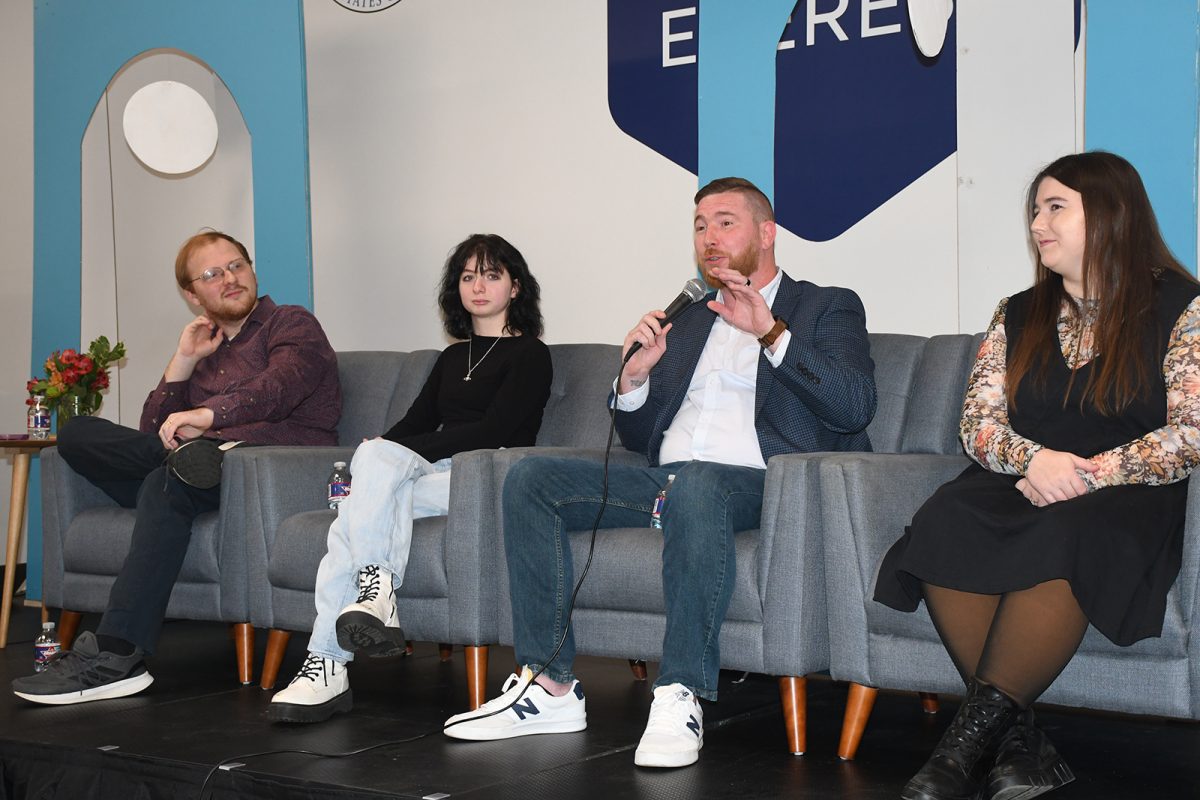
Base Camp Coding Academy graduates who served on the impact panel at last Thursday’s event are (from left) Logan Coley, Anna McLeod, Patrick Pettit and Kera Wicker.
WATER VALLEY — The first Base Camp Coding Academy Alumni Impact Panel drew a full house last Thursday morning as more than 100 students from a half-dozen different high schools and professionals gathered for an honest look at how a small-town tech program is changing lives and how much perseverance it takes to make it.
The two-hour event, hosted by the Base Camp Alumni Association at Everest, featured graduates who turned the yearlong program into careers with C Spire, Cotality, Walmart and Quality Transmission. Moderator Diana Richardson, a senior product manager at Cotality and longtime Base Camp volunteer, guided the conversation with questions that mixed humor and insight.

Gabriel Adams, founder of the Base Camp Alumni Association and a 2023 graduate of the program, shares her story during the Base Camp Coding Academy Alumni Impact Panel held Thursday at Everest in Water Valley.
The panel opened with introductory remarks from Gabriel Adams, founder of the Base Camp Alumni Association and a 2023 graduate of the program. Adams, who graduated from Oxford High School in 2022 and joined C Spire as a software developer just one year after completing Base Camp, shared her story of hard work and transformation.
“I worked my butt off, it was hard,” Adams said. “I was an A–B student in high school, and coming here was a struggle. But I pushed through.” She said her journey shows what can happen when opportunity meets effort. “We want to host events like this to show how your life can really change in a year,” she said about the alumni association. “Stories at Base Camp may seem crazy or unrealistic, but they’re not. Most of our lives really, really changed after Base Camp.”
Adams said the program gave her a foundation to launch her career and continue her education. “I’m now working full time and pursuing my third college degree — all because of the start Base Camp gave me,” she said.
Base Camp graduate and alumni association co-founder Cannon Narmour followed Adams’ remarks, sharing his story of growing up in Southaven with limited resources and finding a career path through the academy. “Base Camp gave me a way forward offering skills, connections, and a reason to keep going,” he said.
Panelists Logan Coley and Anna McLeod completed the traditional post–high school program, while Patrick Pettit and Kera Wicker graduated from the Graduate Institute, a track for adults changing careers. The Graduate Institute meets three days a week, offering a flexible schedule that allows adults to continue working while training for a new career in software development.
Their stories varied, but each came back to a shared theme of resilience.
Coley, now an automation test analyst at C Spire, said he failed several benchmark exams before finally passing.
“Failure was the best teacher,” he said. McLeod, also at C Spire, said her biggest hurdle was confidence. “Everyone thinks they’re not smart enough at first. The truth is, we all start from zero,” she said.
Pettit, an IT manager at a Walmart distribution center in New Albany, juggled work and family while attending Base Camp. “It was tough — I’d start work at 4 a.m. and go straight to class,” he said. “But the mentorship and teamwork here prepared me to lead.” Wicker, now Chief Career Officer for the alumni association and an IT manager at Quality Transmission, said she learned time management the hard way while caring for a newborn during her year at Base Camp. “I lived on a schedule, but I made it work,” she said.
Each graduate described Base Camp as equal parts pressure and support. They credited the academy’s “no-jerk” culture, tight-knit teamwork, and periodic benchmarks for building persistence. “You’ll hit walls,” Pettit said. “What matters is that you learn to get back up.”
Panelists also stressed mastering the basics before relying on AI. “Don’t let technology do your thinking for you,” McLeod said. “Understand the code first.”
Base Camp founder Kagan Coughlin said last week’s event reflects how far the program has come since it opened in 2016. “We’ve had about 180 graduates so far,” he said. “The alumni association shows it’s not just a school anymore, it’s a community.”
Coughlin said students still face the same challenge: learning to push through failure. “Everyone hits a wall,” he said. “Our job is to help them climb over it.” He added that while graduates now work across Mississippi and beyond, recruiting local students from Water Valley remains harder than expected. “Sometimes, when something great is right in your backyard, people don’t realize what they have,” he said.
About Base Camp Coding Academy
Founded in 2016, Base Camp Coding Academy was created to provide a pathway for under-advantaged Mississippians to enter the technology workforce. The program’s goal is to build a pipeline connecting talented, hard-working students with high-demand careers in software development through immersive, hands-on learning.
Base Camp offers both recent high school graduates and adults a one-year, tuition-free program that provides college credit and real-world experience in coding, app development, project management, and leadership skills.
The curriculum is designed to mirror professional software environments, covering technologies such as Python, Django, HTML, CSS, JavaScript, Java, and SQL (PostgreSQL). Students learn using tools like Visual Studio Code, IntelliJ, and PgAdmin in a fast-paced program aligned with employer needs.
Since its founding, Base Camp has earned strong support from the business community as a new source of homegrown tech talent. About 90 percent of graduates have received job offers in the IT field or gone on to pursue computer science degrees at traditional colleges and universities.