School Hearing Lasts Eight Hours
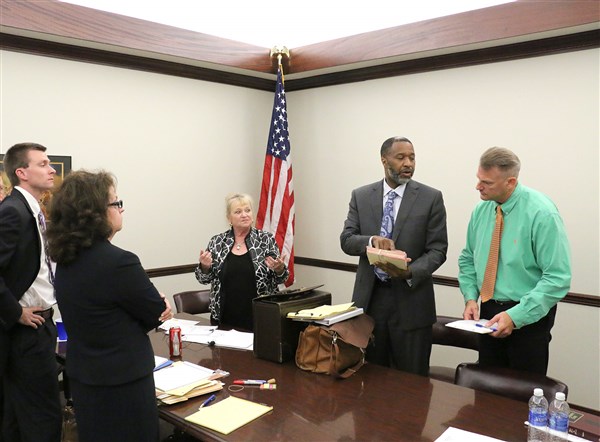
Superintendent Dr. Michael McInnis (right) discusses exhibits with hearing office Nathaniel Armistad at the conclusion of Friday’s hearing at the school. Justin Geurin (left) appealed his dismissal during the eight-hour hearing. He was represented by Memphis attorney Wendy Geurin Smith (right of Geurin).
School Hearing Lasts Eight Hours
By David Howell
Editor
WATER VALLEY – Eigh-teen days after his early dismissal, Water Valley High School (WVHS) principal Justin Geurin’s appeal was held Friday at the school’s central office. Geurin was dismissed by superintendent Dr. Michael McInnis on Sept. 14, 10 weeks into his 12-month contract.
Hearing officer Natha-niel Armistad presided over the meeting, with Jackson attorney John Hooks representing the school district and Memphis attorney Wendy Geurin Smith representing Geurin as multiple witnesses were called and testimony recorded by a court reporter.
As part of the protocol for the hearing, members of the Water Valley School Board were not present and will instead issue a ruling within 30 days from receiving the hearing officer’s report and transcript from the hearing, along with listening to closing arguments. The hearing officer also has 30 days to submit his report to the school board after receiving the transcript, which means it could be up to 60 days before a final decision is rendered.
The board room was packed with members of the community and students, prompting McInnis to warn students that they should be properly checked out to miss class.
The testimony lasted a grueling eight hours in a court atmosphere, as the school attorney called three witnesses to document their allegations that hinged on a missed meeting by Geurin with curriculum director Sharon Lipsey on Sept. 3 after he had not completed the MPES (Mississippi Principal Evaluation System) deadline, incomplete assessments for 10th and 11th grade students on the I-Ready system, and the lack of entries into ELS (Education Leadership Solutions).
Geurin’s attorney addressed each claim, calling five witnesses during the day to counter the school allegations. Smith also argued that none of the allegations were strong enough to warrant the principal’s abrupt termination.
“The purpose in today’s hearing is not to show that Mr. Geurin is perfect. In labeling things as perfect, we are saying that it conforms with a standard that is clearly defined,” Smith said in an opening statement as the hearing got underway. “Such perfection will never be attained if the benchmarks are nebulous, unclear or capriciously changed.”
Smith added the purpose of the hearing is an effort for due process as defined by statute, case law and written policy to determine if Mr. Geurin’s performance as principal of WVHS rose to the level of immediate dismissal.
“Our position is startlingly clear that his performance did not even approach a level deserving of such treatment, Smith said, adding the problem today stemmed from failure to communicate.
During the morning, the school district called three witnesses to the stand, Lipsey; interim assistant WVHS principal Cathy True and McInnis.
School Provides Testimony
Lipsey spoke first, testifying her duties include working with teachers, principals and the superintendent to improve the student education at the school. Lipsey testified about a letter she wrote on Sept. 4, identifying problems with the principal’s performance and summarizing a meeting held that day with Geurin, Lipsey and McInnis in attendance. Key focus points recorded in the letter were incomplete testing for I-Ready for 10th and 11th grade students and not starting or completing work on the MPES (Mississippi Principal Evaluation System). Lipsey testified Geurin’s deadline to complete MPES was Sept. 3.
Lipsey described I-Ready as a diagnostic assessment given to students to evaluate their learning level and appropriate intervention needed.
Lipsey then testified she sent Geurin an email on Aug. 27, reminding him he was responsible for the MPES evaluations for assistant principal Drew Pitcock, alternative school administrator Chester Drewery and vocational administrator Michael Cook. Lipsey said she recommended Geurin tell the group to start setting their goals for the school year. Following the Aug. 27 email, Lipsey testified there was an administrators meeting on Aug. 31, and she sent Geurin and Davidson Elementary School (DES) principal Brad Parker a recap by email, informing each principal of the meeting on Sept. 3. at 1:30 p.m.
“Each principal had to obtain signed documents of administrators’ evaluated professional growth goals, goal setting, and the action plan of how they intended to meet those goals,” Lipsey testified.
Lipsey said she also sent a reminder on the morning of the meeting, reminding the principals of the meeting to discuss and sign off on MPES.
“Mr. Geurin did not show up for the meeting,” Lipsey testified.
Lipsey also testified she made a trip to the high school that same day to speak with Geurin regarding the student’s Average Daily Attendance, and left Geurin a note to call her after she was told the principal was in meeting.
“He did not call me,” Lipsey added.
Next the school district’s attorney questioned the I-Ready testing underway at the high school.
“After checking the high school’s I-Ready data, I realized the students in the 10th and 11th grade were not being tested,” Lipsey explained.
Lipsey testified that she sent Geurin an email on Sept. 1, asking for his testing schedule and completion date.
“I did not get a response from Mr. Geurin,” Lipsey testified.
Lipsey also testified that only five students in the two grades had been assessed as of Sept. 4, while the assessments had been completed at DES.
Lipsey also said the MPES is critical and could impact the school’s accreditation if the school is audited.
In closing, Lipsey testified the importance of I-Ready assessments for the 10th and 11 graders was to help the high school’s student drop-out rate, which has been historically low and impacts the school’s annual rating. She also testified that the importance of the diagnostic I-Ready screening was effectively communicated to Geurin.
On cross examination, Smith questioned Lipsey’s communication with Geurin alerting him of the Sept. 3 meeting that was not attended by the principal scheduled at 1:30 that afternoon.
Lipsey again pointed to an email sent on the morning of the meeting just before 8 a.m. and a later visit to the high school with a note for Geurin to call her.
Answering questions by Smith, Lipsey confirmed that Geurin’s duties as principal keep him out of his office frequently during the day.
Smith also questioned Lipsey about the I-Ready assessments for the 10th and 11th grade, specifically when Geurin was notified that the assessments needed to conducted on students in the two grades and the availability of computer lab time for the students to complete the testing.
“How was it determined that the principals’ (MPES) evaluations needed to be completed by Sept. 3?” Smith asked.
Lipsey testified the Aug. 31 deadline had been missed, and Sept. 3 was the next closest date and the MPES goals were required by the superintendent to be set by that date.
Smith then asked about the data available for Geurin to set the goals for MPES, a point that would resurface during the day as multiple witnesses explained that much of the testing data from the previous school year was not available statewide.
Smith also questioned when Geurin was instructed to test the 10th and 11th grade students for I-Ready. Lipsey testified that the decision to test all 10th and 11th grade students was made on August 26.
“Is it your testimony that Mr. Geurin agreed to have the I-Ready
Smith also questioned the frequency of meetings Lipsey has each day, which was determined to be two or three.
Second Witness
The school district’s second witness to take the stand was interim WVHS assistant principal and professional development coordinator Kathy True.
The bulk of True’s testimony pertained to the school’s ELS (Educational Leadership Solutions), a software program used by the school for teachers to enter lesson plans and administrators to enter teacher observations after visiting classrooms to observe ongoing instruction. True stated the data helps track goals for the year and indicates that students are engaged in the learning process.
True also testified the importance of the classroom observations that are entered into ELS, explaining that the superintendent can see what his administrators are accomplishing and allows teachers to see feedback from the administrator visiting the classroom.
After explaining the purpose of ELS, True testified that Geurin’s entries from classroom evaluations were lower than other administrators.
True’s timeline in her testimony Friday started with a Sept. 15 letter she wrote for McInnis stating the procedure she had gone through with Geurin explaining to him about putting his observations in the ELS. True said the Sept. 15 letters referenced a conversation between True and McInnis about three weeks earlier about Geurin’s observations not being entered into ELS.
True testified that she visited Geurin about three weeks before Sept. 15, instructing Geurin to put teacher observations into ELS based on McInnis’ concerns.
True then testified on Sept. 11, she told Geurin again that McInnis expected observations to be entered into ELS.
On Sept. 11, True said a noticeable number of observations had still not been entered in ELS and she again instructed Geurin about the need to enter the observations into ELS. True said Geurin indicated he had observations on paper that needed be entered into ELS.
True also testified that Geurin noted that the school’s WiFi system was not strong enough to give him interest access on his iPad, which complicated the process because he had to write his observations on paper and then go back and enter them into ELS instead of entering his observations directly into the system while conducting the observations in the classroom.
Citing ELS data, True then testified that Vocational Director Michael Cook and assistant principal Drew Pitcock (now interim principal at WVHS) had entered substantially more observations into ELS during the same period.
Next True testified Geurin had entered multiple teacher evaluations into ELS after his termination even though she had attempted to block his account. She said his entries jumped from 19 when he was dismissed to 58 several days later.
True’s final testimony, again in response to Hooks’ questions, said teacher evaluations by Cook for non-vocational teachers are against Mississippi Department of Education policy because he is paid by vocational.
In cross examination, Geurin’s attorney asked True if she was aware the Sept. 15 memo prepared for Dr. McInnis documenting the problems came after Geurin’s termination.
True testified that she had been asked by Dr. McInnis to prepare the memo the day after the termination.
Responding to Smith’s questions, True also testified she was aware of the problems with Geurin’s WiFi. True agreed the problem could slow down the evaluation process, but the info could have been entered at a desktop computer.
True also testified there was no written protocol from the school district regarding the number of evaluations required by Geurin or other administrators or how fast observations are required to be entered into ELS.
Superintendent Takes The Stand
McInnis took the stand as the last witness before the lunch break and the final witness for the school district before the defense mounted their case. As preliminary info, McInnis testified he had worked as superintendent at Union Public School district for six years and two years as assistant superintendent at Grenada School District.
McInnis first explained that he had recommended Geurin to the school board after interviewing five candidates to lead the high school. The superintendent then referenced the Sept. 14 termination letter, explaining Geurin had been dismissed for neglect of duty.
The superintendent addressed issues outlined in the termination letter, starting with I-Ready testing for students in 10th and 11th grades. McInnis said the change to use I-Ready came after educators tested the system over the summer and recommended the change.
McInnis testified that the initial diagnostics using I-Ready for students in kindergarten to sixth grade indicated the students’ results were right on track. However with students in grades 67th – 9th, the superintendent explained the results were extremely alarming, based on reading levels and other indicators.
“Because of our low graduation rate and high dropout rate, we made the decision to address 10th and 11th graders,” McInnis continued. The goal was to identify students needing intervention, he added.
McInnis then said he communicated the directive to test the additional two grades to Geurin “to the very best of my ability.”
McInnis then said he was alarmed when only five students in the two grades were tested after requesting all of the students to be tested on I-Ready.
McInnis also testified about a written reprimand issued to Geurin citing deadlines missed by the principal including providing results of a school safety walk-through along with keys to the junior high and high school classrooms and the other matters referenced during the hearing.
McInnis testified he met with Geurin numerous times, starting on July 1, including an estimated six formal meetings with the school’s business manager, Randy Goodwin, in attendance to talk with the principal about missed deadlines and to offer suggestions for improvements.
The suggestions included visiting other school districts, including the top rated district in the state, to get another look at other administrative styles.
“Mr. Geurin was brand new to the principalship and we wanted to set him up for success,” the superintendent added. The visits would provide input on improving test scores, graduation rates and other key factors for school success, McInnis said.
The visits were not scheduled, according to McInnis after several weeks of conversation about the matter.
“I am very, very passionate about what I am doing. I was charged by the school board to move us from a D to an A school district. We don’t have time to waste… We have these kids for 180 days… that is why I was pushing,” McInnis said.
The superintendent then testified that former principal and assistant superintendent Jerry Holt was assigned to Geurin as a mentor to help him be successful.
“Mr. Geurin was all for it,” McInnis added.
McInnis then testified that Holt ultimately told him that Geurin did not appear to be taking him very seriously.
Next, McInnis testified that the Sept. 4 letter written by Lipsey changed his opinion about the principal’s continued employment, even though only a day earlier McInnis had given Geurin a plan of improvement letter with an October 1 deadline.
In his final testimony before cross-examination, McInnis said he believed he had had sufficient amount of time in evaluating Geurin’s progress in meeting these objectives.
“We had at least six formal conversations regarding things that were not being done. Just walking through the schools and talking, it was just very, very evident that things were not being done,” the superintendent.
McInnis’ testimony then reiterated the earlier allegations with classroom observations, and offered his opinion that Geurin was not in the classrooms based on the number of observations entered into the ELS.
McInnis also stated that the assistant principal at the high school had made 166 observations, while Geurin had made 19, citing the start of the school year through Sept. 10. McInnis acknowledged Geurin likely had made additional observations, but they were not entered into the computer and not helpful to the teachers.
Also cited were discipline referral slips allegedly not entered into the computer system from the previous school year, an allegation that surfaced multiple times in Friday’s hearing as other witnesses testified about what could be a breach in protocol for the slips.
McInnis Fields Tough Questions
After a lunch break, Smith grilled McInnis for almost an hour on cross examination, first asking if Geurin had been unanimously recommended by a search committee charged with evaluating with candidates for the job.
“Yes,” McInnis answered.
Smith then asked if other diagnostic testing for students used at the school in addition to I-Ready.
“Yes,” McInnis answered.
“How often are you testing your students?” Smith asked.
“Too much… we test too much, but I don’t know the answer to that,” McInnis answered.
Smith then asked about the frequency of computer generated testing.
“The frequency, I’m not sure of,” McInnis answered. “We do diagnostics with the kids to see how much growth we are doing,” he explained.
“How long does it take to test one student on I-Ready?” Smith asked.
“I’m not sure,” the superintendent answered.
Responding to Smith, McInnis testified that initially I-Ready testing was slated for grades K-8th, but added that was in the infancy of implementing the system.
“When was the decision to test the 9th graders?” Smith asked. “Would it have been before August 3 or after August 3?” Smith asked when McInnis said he was not sure of the date.
“I’m not sure,” McInnis answered.
“When was the decision made to test the 10th and 11th graders?” Smith asked.
“I will have to go back to what Ms. Lipsey said,” McInnis responded.
“So you have not recollection of when you made the decision to start testing the 10th and 11th graders?” Smith asked.
“As I said, I will have to refer back to what Ms. Lipsey said,” McInnis repeated. “Looks like it was on August 28,” he added, after examining the correspondence.
“After the school year had started?” McInnis started.
“That’s correct,” McInnis answered.
“School had been in session for about four weeks, is that correct?” Smith asked.
“Give or take,” McInnis answered.
McInnis also could not answer Smith’s question if the 10th and 11th graders have lab/computer instruction course.
“To answer that question I would have to have a high school schedule,” McInnis answered.
“How many 10th and 11th graders do you have?” Smith asked.
“I think Ms. Lipsey answered that question… I do not have that number in my documentation,” McInnis answered.
“Just an estimate,” Smith prodded.
“I don’t do estimates, I like accuracy,” McInnis answered.
“Almost 200?” Smith answered.
“I don’t do know, if you will let me run a report,” McInnis said.
We can move on. You stated that Water Valley is a D school and you were using the I-Ready to start your testing to improve the Water Valley school. And the MPES data… is that correct?” Smith asked.
“That is just one small component that we are introducing to move us from a D school to an A school district. We have a number of other strategies that we are implementing as well,” McInnis answered.
“What data did you review that stated that Water Valley was a D school?”
“The previous year’s test scores,” McInnis answered.
“Would that be for 2013-2014, or 2014-2015?” Smith asked.
“I don’t know. It’s been a D school district for a number of years,” the superintendent explained.
“Have you received the school data for 2014-15?” Smith asked.
“We received Biology, U.S. History, fifth and eight grade science,” McInnis answered.
“When did you receive that?” Smith asked.
“A month ago, a month and a half ago,” McInnis answered.
“Are you aware that the MPES deadlines for evaluations have been moved to Dec. 31?” Smith asked, citing the change by the Mississippi Department of Education (MDE).
“I’m not sure of MDE’s deadline, my instructions were Sept. 3,” McInnis answered, adding it had been clearly communicated.
McInnis acknowledged the two principals were confused on the data they would use to submit goals for MPES, but had instructed Lipsey to help the principals enter the info.
Smith then questioned McInnis about the formal meetings held with Geurin with Goodwin present.
“Why was Mr. Goodwin in those meetings?” she asked.
“Anytime I talk with staff regarding personnel issues, I always have somebody present,” McInnis answered.
“Was Mr. Geurin aware you were discussing a personnel issue?” Smith asked.
“Yes,” McInnis answered.
“How was that communicated to him?” Smith continued
“By our dialogue,” the superintendent answered
“Anything in writing?” Smith asked.
“No, these were just verbal. The purpose of those meetings, since you brought it up, was to point out some of the things that were not going right… reaching out to Mr. Geurin, what can we do to help. Yes, at times I was very, very direct in sharing my disappoint… But the meetings would always end with Mr. Geurin, you are my high school principal. I want you to succeed. What do I need to do to help you be successful?” McInnis answered.
“What time of day were those meetings?” Smith asked.
“I’m not sure,” McInnis answered, citing the same answer when she asked if the meeting were before school, after school or during the school day.
McInnis acknowledged some of the meetings were requested for Geurin to appear within an hour and he also had regularly scheduled meetings with the principals.
“Is it true that told Mr. Geurin that Jerry Holt was very complimentary of his performance?” Smith asked.
“I do not recall that,” McInnis answered.
McInnis testified also did not recall the date of the meetings when Holt visited Geurin. He also testified that Holt did not take compensation for his role because of his love for the district and the lack of success.
Smith’s questioning continued, asking specific questions about the superintendent’s time spent in the classroom and the estimated number of teachers.
McInnis stated he did not know the exact number of teachers.
Smith’s questions then transitioned to the Sept. 3 letter presented to Geurin, giving him until the end of the month to complete specified tasks and they would meet on Oct 1. She also noted that Geurin’s name was misspelled on the letter.
“Yet you terminated him on Sept. 14?” Smith noted. “You believe Mr. Geurin’s job performance warranted a termination prior to the date you gave him?” Smith asked, noting the time span from Sept. 3 to 14 included a three-day weekend for Labor Day and another weekend.
McInnis testified events occurred after Sept. 3 meeting that influenced him to an alarming degree, “Not just the small things that were not being, but things getting us in trouble with MDE with accreditation, and also with the I-Ready,” he added before the lawyers had a brief dispute about the manner in which the questions were being answered.
After the court reporter read the last dialogue, McInnis answered the specific question, “What events were so serious that changed your opinion in giving my client an opportunity to perform?” from Smith.
“We are a D school district. We have an alarming number of students that are from junior even to 9th grade that are at least two grades in reading below level. We have no time, we are already behind the game in providing intervention for these kids. I-Ready was the diagnostic instrument we are using to identify those kids and and put those students in intervention and catch them up,” McInnis said, adding he was not made aware of any logistical problems with I-Ready.
McInnis also noted the students’ time would be better suited in the classroom rather than attending the hearing.
McInnis said he learned on Sept. 4 that only five students had been tested, and Geurin had missed the meeting with Lipsey. He said Geurin told him he lost track of time after missing the meeting and acknowledged that he had not contacted Lipsey about the missed meeting.
“Have you ever missed a meeting?” Smith asked.
As a superintendent, I never miss a school board meeting. As an assistant superintendent, I never missed a meeting with the superintendent,” McInnis answered.
Smith then transitioned to questioning Drew Pitcock’s role, first as assistant principal at WVHS and then as interim high school principal. McInnis also acknowledged he had worked with Pitcock at the Grenada School District.
Smith then asked about music playing in McInnis’ office during the day and when he was meeting with Geurin, and specifically during the Sept. 3 meeting.
McInnis answered that he does play music in his office, but was not sure if it was playing on the Sept. 3 meeting date with Geurin.
“Other than your testimony that there were problems with I-Ready, MPES and ELS, there are no other events pointing to an early termination of Mr. Geurin?” Smith asked.
“To answer your question, it kept building and building. That was the straw that broke the camel’s back,” McInnis said, referencing additional problems.
“What was the straw?” Smith asked, pointing to separate documents entered into evidence. Smith noted the Sept. 3 meeting when Geurin was issued a plan of improvement with the October 1 deadline. Then she referenced the Sept. 4 letter outlining additional problems and Smith questioned if the later memo superseded the Sept. 3 plan of improvement.
“Yes,” McInnis answered. “This is a D school district, there is no reason it should be a D school district. It is the vision of the school board, the community that we become an A or B school district,” he explained, adding the district rating affects the economic development for the community. “The main thing and the reason I am an educator is to provide educational excellence for the students… I could not, in good conscience, walk the halls of the junior high and high school and look at the students and know they were receiving nothing less than educational excellence,” McInnis said. “… all of the assets I gave Mr. Geurin, to sincerely help him, and the pep talks I gave him, it just was not getting done.”
“How long is your contract,” Smith asked.
McInnis asked his attorney if he was required to answer the question pertaining to personnel, but was directed to by the hearing officer.
“I have a three year contract,” McInnis answered, prompting Smith to note he had multiple years to make make change and Geurin has a one year contract.
Responding to Smith’s questions, McInnis testified that Geurin had never shown up under the influence of any intoxicants, or mistreated students, or to have demonstrated conduct.
When questioned about his time spent in the classroom, McInnis testified that would like to walk the halls every day but this employment matter had consumed his time.
Smith also questioned if McInnis left the campus shortly after the end of the school day and if he had ever met with Geurin after the school day, explaining that multiple meetings held with Geurin were held during classroom time. McInnis agreed most of the meetings were held during the school day, adding the meetings were brief. McInnis said his scheduled varied, as to the question about when he left the campus.
Smith finally asked if McInnis was familiar with the names of specific teachers in various roles in the high school.
“I will save you time on that, I don’t know the teachers’ names yet. I just started here June 1,” McInnis answered.
Smith then noted multiple new team members including Geurin were charged to work together to bring change to the district as hour-long questioning of McInnis came to an end and the school district rested.
Geurin Takes The Stand
Geurin’s defense started with his testimony, starting with basic employment information that included two years assistant principal and as teacher prior to coming to Water Valley.
Smith’s questions started with the transition that occurred during his first year as assistant principal following the death of DES principal Dr. Carol
Gary. Dr. Glenn Kitchens was moved to DES as an interim principal serving the remainder of the 2013-14 school year, giving Geurin additional duties.
Geurin then described his typical day in his role as principal, explaining he arrives around 6:30 in the morning, turns on the lights and gets the campus ready for the day. He testified that he started fielding calls from sick teachers around 6:45, and lines up substitutes. Students then start arriving on the campus around 7:30 and the day starts.
Geurin also testified he had regularly scheduled meetings with McInnis.
Next he testified he had responsibilities after the school day, catching up on paperwork, and often working athletic events that can also include Saturdays. He also stated he regularly came back to the school later in the evening to work.
“Do you ever feel overwhelmed in the duties that you have as principal?” Smith asked.
“Yes, I think if you are not overwhelmed in this type of position, you are not doing it right,” Geurin said, adding that he had not expressed that to the superintendent.
“Do you feel confident to do this job?” Smith said.
“100 percent,” Geurin said, then citing his educational background including a master’s degree and currently work on a doctoral degree.
Geurin then fielded questions about I-Ready, noting that he had traveled to Grenada to observe the software at Grenada before the school transitioned to the software.
Geurin testified that educators at the Grenada School District had mixed reviews of testing upper grade level students with I-Ready. He said original discussion with Lipsey included testing 7th and 8th graders, and later the decision was made to test the 9th graders. Geurin also testified that he was made aware on Aug. 26 that 10th and 11th graders would be tested on I-Ready, and he needed to implement a schedule for the testing the students by Sept. 3. He also testified he told Lipsey that he would make every effort to meet the Sept. 11 deadline, but he also noted there are almost 150 students in the two grades who do not have dedicated lab time during the day.
He also said I-Ready recommended four, 45-minute session for testing, which meant it would take about four class sessions to complete testing for each student. Geurin testified the school has 96 computers to accommodate the testing, when not in use for regularly scheduled lab time for other students.
“We don’t want to pull a student from a core class to do a diagnostic. That is a day in that class they will never get back…Since my arrival on campus, that has been a struggle, getting screeners completed for all students in a timely manner,” Geurin explained, explaining that the screener is the actual test.
Geurin testified that initial start date for 7th, 8th and 9th grade testing was pushed back a week because the computers were not ready, and there were also reports of occasional random issues with computers.
“At any time did you agree to have the I-Ready testing completed by Sept. 11?” Smith questioned.
I did, I said we would make every possible attempt to have that done,” adding that he told Lipsey it would to? get that done. He also outlined steps he took, including giving teachers late notice they would be working the labs for the next four days to get testing done.