Supervisors Weigh Dispatch Move
PROTECTED CONTENT
If you’re a current subscriber, log in below. If you would like to subscribe, please click the subscribe tab above.
Username and Password Help
Please enter your email and we will send you a password reset link.
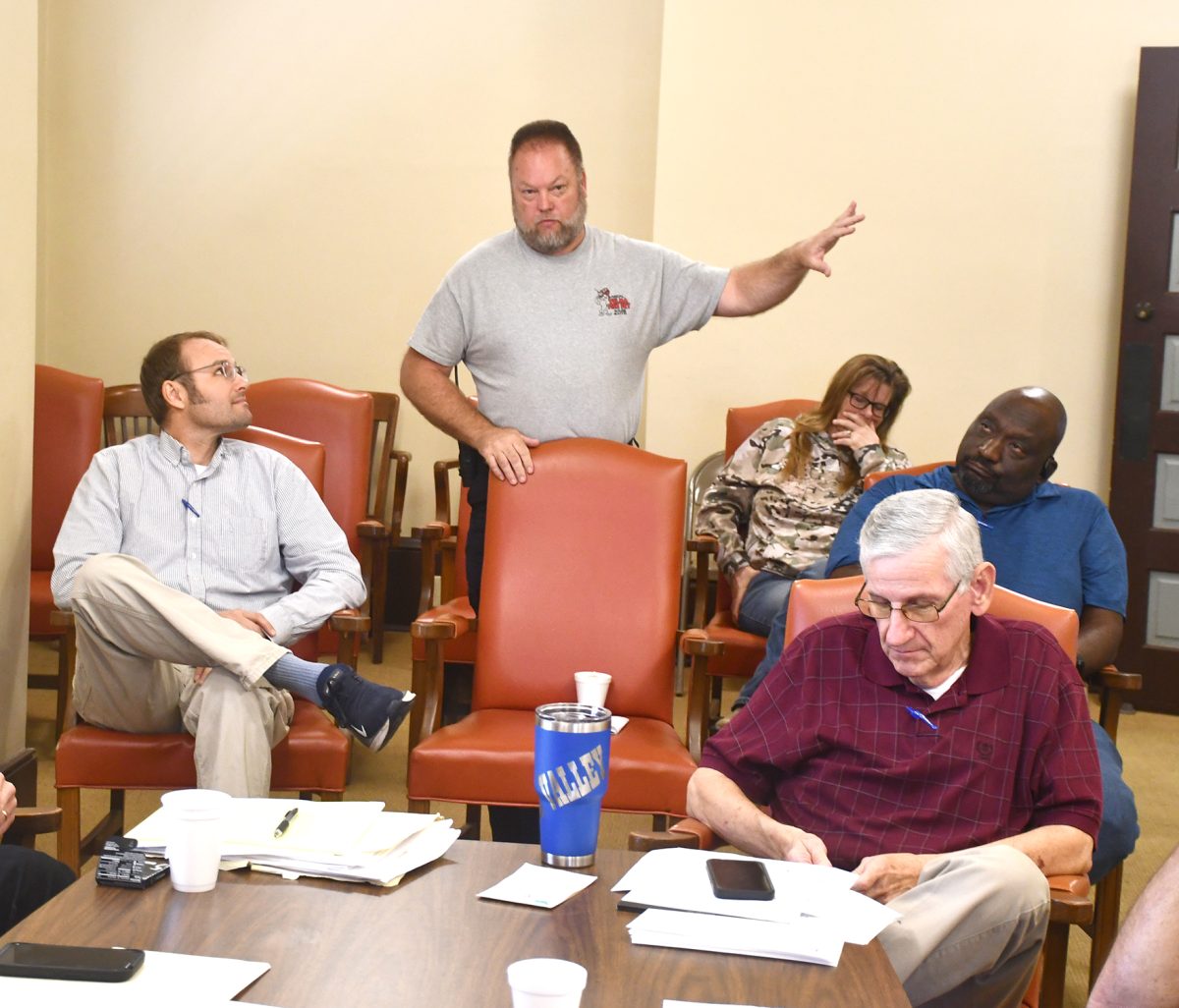
Yalobusha County Emergency Management Director Stewart Spence (standing) shares concerns about dispatcher safety.
WATER VALLEY – A longstanding arrangement that requires Yalobusha County dispatchers to perform dual responsibilities inside the jail is drawing renewed scrutiny as county supervisors weigh the costs of separating the county’s 911 communications center from the detention facility.
The issue surfaced during two meetings last week, a closed-door session Monday, Oct. 5, and a special meeting Friday, Oct. 9, following safety concerns raised by a dispatcher. The earlier discussion was held in executive session, with personnel matters cited as the reason.
Supervisors took no formal action Friday but discussed the possibility of moving dispatch by August 2027, giving the county time to address the estimated $200,000 cost of a new communications center and an additional $250,000 annually for increased jail staffing.
Board President Cayce Washington explained during Friday’s meeting that safety concerns and distractions that could interfere with emergency calls had brought renewed attention to the issue. Washington cited concerns about jailers having keys to the communications room inside the jail, an area dispatchers have regarded as a safe place.
“I understand some dispatchers have raised concerns about what could happen if a jailer got into a struggle with an inmate and the inmate gained access to the key,” Washington said.
Yalobusha County Emergency Management Director Stewart Spence raised the same concern.
“The concern brought to our attention is what could happen if a jailer were overpowered by an inmate,” Spence said.
The cost of moving dispatch outside the Yalobusha County Detention Center was the primary focus of Friday’s two-hour meeting. Washington reported that the quarter-million-dollar figure would fund four additional jailers, allowing the sheriff’s department to have two jailers on duty during each shift.
For more than a decade, dispatchers have performed jail duties in addition to answering emergency calls, allowing the county to operate the detention facility with only one jailer on duty per shift.
Washington also presented cost estimates for a small building to house the dispatch center. One option was a modular building priced at approximately $150,000, with another $50,000 needed for site preparation, utilities, communications connections and installation. The total estimated cost was $200,000.
“The initial cost is one thing. The recurring cost is going to be providing the sheriff with jailers,” Washington said.
Sheriff Jerimaine Gooch questioned why the longstanding practice had become an urgent safety concern now.
“It’s always been like that, Cayce,” Gooch said.
Gooch reminded supervisors that he had requested funding for additional jailers earlier in the summer as part of budget deliberations to help address the concerns, a request supervisors denied.
The sheriff also pointed out that the possibility of a jailer being overpowered exists in any detention facility.
“It could happen in any jail,” Gooch said, noting that even maximum-security facilities are not immune to such risks.
Washington also questioned how disturbances inside the jail could affect dispatchers handling emergency calls, citing the possibility of a dispatcher talking to someone contemplating suicide while simultaneously monitoring inmates.
“I would hate to know that we have someone out here that’s on the edge of suicide. And they’re talking to a dispatcher who is struggling to focus because of a disturbance inside the jail,” Washington said.
Jail History
The county moved its dispatch operation into the newly constructed detention center in Water Valley in 2015, after the sheriff’s department assumed countywide dispatching duties. Previously, dispatchers had worked out of the Water Valley Police Department.
Gooch agreed during Friday’s meeting that dispatch should not have been located inside the jail in the first place, reiterating that the detention center should have been staffed with at least two jailers per shift rather than relying on dispatchers to assist with jail operations.
The current arrangement requires dispatchers to answer emergency calls while monitoring jail security cameras, operating electronic doors and assisting jail personnel.
Although dispatch remained inside the jail, oversight of the operation shifted from the sheriff’s department to the county’s Emergency Management Agency under Spence in 2022.
The Herald previously reported in August 2023 that supervisors were discussing the possibility of moving dispatch out of the jail and how to pay for it.
“I know one of the challenges we fight is the location of the dispatch center,” Washington said at the time.
The same questions were before supervisors Friday.
“I know we’ve been talking about this for three or four years now, or longer,” Washington said.
Dispatcher Lara O’Neal told supervisors that another problem is the lack of written guidelines defining the responsibilities of dispatchers working inside the jail.
“There’s just a lack of clarity of what is expected of us while we’re in there,” O’Neal said.
She said dispatchers need clearer instructions about operating security doors, dealing with inmate trustees and communicating with jail personnel.
Gooch noted that although dispatchers work inside his facility, they fall under Spence’s supervision.
“When I have a problem with these dispatchers, I always go to Stewart,” Gooch said.
“I think what they’re asking for is clear instruction that is documented. That protects you and them,” Washington said.
Long-Term Costs
Washington estimated that hiring four additional jailers would require revenue equivalent to approximately 2.5 mills in property taxes.
“I think we owe it to the sheriff and to the dispatchers a plan of action that we’re going to act on,” Washington said.
District 3 Supervisor Kenny Harmon agreed that separating dispatch from the jail was needed but questioned where the county would find the money.
“I understand it may be something that we need, but man, don’t ask me to write a list of what we need because there’s not enough paper in the world to do it,” Harmon said.
“Do we need to do it? Yes. Do we need some new fire trucks? Yes. Do I need to work on my roads? Yes. Bridges falling in? Yes. Do our employees need raises? Yes,” Harmon said.
District 2 Supervisor Ken Rogers pointed out that the county would eventually face the expense of additional jail personnel regardless of when dispatch was relocated.
District 4 Supervisor Eddie Harris suggested using $400,000 from the county’s garbage fund, which has accumulated approximately $777,000 in reserves. His proposal would put $200,000 toward a new dispatch building and another $200,000 toward the first year’s cost of additional jailers.
Harris’ suggestion raised questions about whether garbage fund money could legally be used for an unrelated county expense. District 5 Supervisor Gaylon Gray also questioned the proposal, noting that garbage collections and expenses were running close together.
Harmon questioned how the county would pay for the additional jailers once the first year’s money was exhausted.
“Once we make the commitment, guys, we will have to, unless we get a crazy increase (in assessed value) next year, we will have to raise taxes to pay the recurring costs of the jailers,” Washington said.
“We’re going to have to raise the millage. I don’t see any way around that.”
Harris pointed to the county’s limited industrial tax base as part of the problem.
“We just don’t have enough industry and enough money coming in, tax money coming in this county,” Harris said. “It’s sad though that we had to put it on the back of the taxpayers.”
Washington indicated he would support considering a tax increase during the next budget year if supervisors agreed that separating dispatch from the jail was a priority, even during an election year when he will be on the ballot.
“Next year’s election year. That’s just the truth. That’s reality,” Washington said. “I’m personally not going to make a political decision. If someone can do this job better than me and can beat me, I want them to do that. But I want to do the best that we can with what we know.”
Gray cautioned that a 2.5-mill increase would place another burden on property owners, particularly as assessments continue to rise.
“That’s a pretty healthy tax increase,” Gray said.
Still, he emphasized that his concerns were financial rather than opposition to relocating dispatch.
“I mean, we’re all in agreement that yes, it’d be a good idea to get them away from there,” Gray said.
Washington suggested giving the county more time to seek outside funding, obtain accurate building estimates and work the cost of additional jailers into the next budget. He asked Sheriff Jerimaine Gooch to update his staffing estimates and raised the possibility of moving dispatch by August 2027.
“We’ve been kicking a can down the road,” Washington acknowledged.
No formal action was taken.