RV Resort Proposed Near Enid Lake
PROTECTED CONTENT
If you’re a current subscriber, log in below. If you would like to subscribe, please click the subscribe tab above.
Username and Password Help
Please enter your email and we will send you a password reset link.
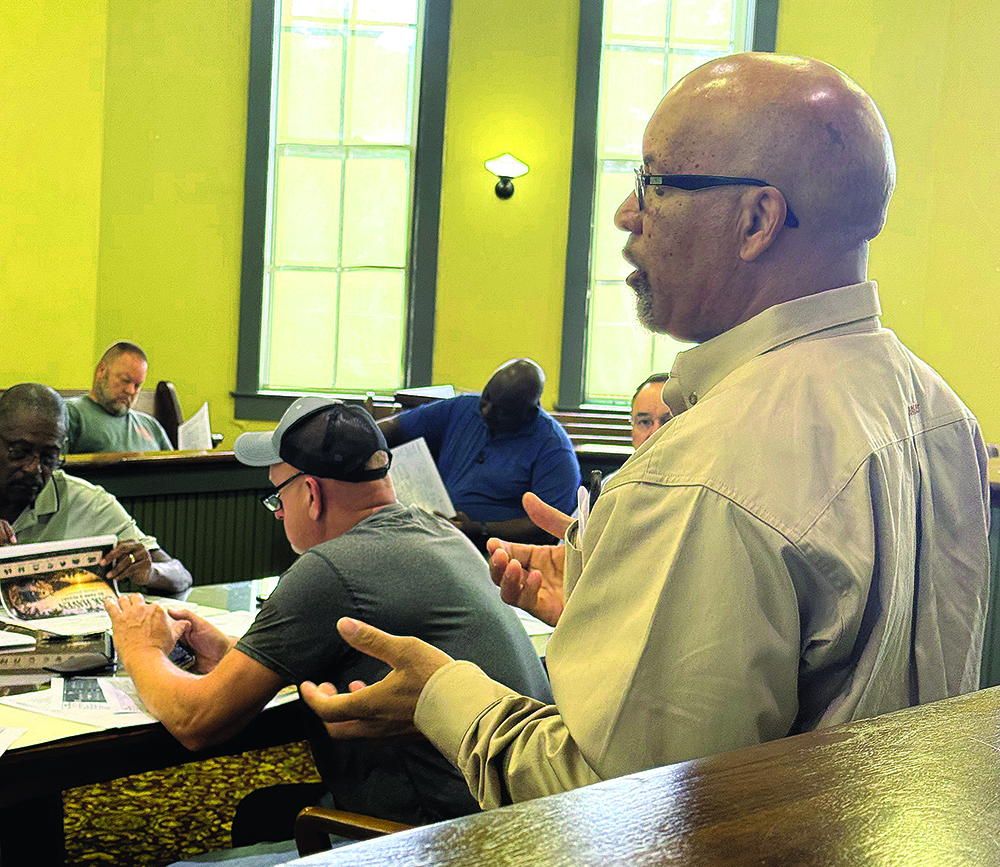
Michael Donald presents plans for Oak Haven RV Park & Resort to the Yalobusha County Board of Supervisors during its Sept. 22 recessed meeting.
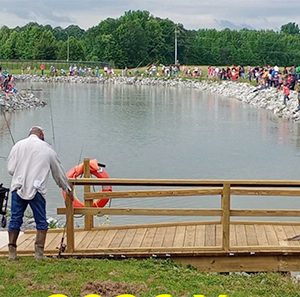
OAKLAND — A Yalobusha County native wants to turn nearly 48 acres near Enid Lake into a destination RV resort featuring 75 campsites, cabins, horse facilities, a fishing pond and storage for RVs and boats.
Michael Donald presented plans for Oak Haven RV Park & Resort to the Yalobusha County Board of Supervisors during its Sept. 22 recessed meeting, outlining a three-phase development on 47.6 acres he owns along County Road 27.
Donald told supervisors the project is something he has been working on since January and is also a homecoming of sorts.
“I would like to bring something back to the community,” Donald said.
Donald said he graduated from Coffeeville High School, where he was in the band, in 1985 and immediately entered the military. He served during Desert Storm and Bosnia before eventually moving to Texas. Donald said he now works for the railroad and travels across the country, but Oak Haven is part of his retirement plan.
He also recalled growing up about two miles from George Payne Cossar State Park, where his family held reunions and he swam in the park pool.
“I am part of the community,” Donald told supervisors.
Donald said the first phase of Oak Haven would encompass about eight acres and include 30 full-hookup RV sites.
“If I heard you right, you are already prepared, funding and everything, for phase one?” Board President Cayce Washington asked.
“Yes, we are ready to do the closing,” Donald replied.
Donald said he would like to break ground as early as October. The master plan calls for the resort to eventually expand to 75 RV sites. Plans also show five to 10 cabins, a roughly 1.5-acre fishing pond, a 10-stall horse barn, a 100-by-200-foot riding arena, nature trails, a dog park, playground, pavilion and picnic areas, camp store, bathhouses and laundry facilities.
RV and boat storage is also planned.
“You won’t have to take your RV or boat all the way back to Memphis or Jackson,” Donald said.
The property would be fenced and equipped with security cameras.
Donald said one feature that would distinguish Oak Haven from many RV developments would be its accommodations for horses. The property adjoins federal land near Enid Lake, an area already popular with hunters, fishermen and outdoor enthusiasts, he added.
“Every year you have people who want to hunt and fish. What makes this project a little bit different is having some horses there. We would like to have a horse arena and horse stalls,” Donald said.
Donald said Oak Haven would also target vacationers as well as contractors and others who may need temporary housing.
However, he said the resort would not become a long-term residential campground. Guest contracts would limit stays to 30 days.
“We don’t want squatters,” Donald said. “We want to keep people coming in and enjoying it.”
Donald said RV owners could also potentially lease their campers through Oak Haven when they are not using them, with the resort maintaining the units.
“A lot of people have RVs and don’t use them but maybe one month a year,” he said.
Donald said rules would be spelled out in a guest handbook and the resort would be geared toward a quieter clientele.
He said the development could eventually employ more than 40 people at full build-out.
Washington praised the amount of work Donald had put into the proposal.
“This is probably one of the most well put-together business plans that has crossed this table that I am aware of, so it tells us what you are trying to do,” Washington said.
The three-phase development carries an estimated construction cost of $3.3 million, according to plans Donald presented to supervisors. The budget includes $850,000 for the first phase, $925,000 for the second and $1.525 million for the third.
The discussion also turned to Stewardship Yalobusha, the county’s long-range plan for growth and development adopted by supervisors in August 2018. The plan established development guidelines covering roads, sewage disposal, emergency access and other infrastructure. Washington said it also gives the county a way to address conflicts between neighboring developments.
“I think the greatest concern and the reason we have the Stewardship Plan is if you go out here and make a substantial investment and then somebody wants to put a hog farm right across from you, you are going to be concerned about that,” Washington said. “That is why we adopted the Stewardship Plan.”
Washington said he believes Oak Haven could significantly affect the area.
“This will dynamically change that area,” he said. “I think it is a positive thing.”
Supervisors then turned to some of the practical issues Donald will have to address before construction, including the condition of County Road 27, fire protection and sewage treatment.
Washington said County Road 27 may need attention to accommodate large motor homes.
“I think the other part of having you here today is because (supervisor) Eddie Harris may have to revisit the way that road is set up,” Washington said. “Because if you are going to be running a 40-foot, $100,000 camper, they are not going to want to hit trees.”
Donald said he has an engineer working with him and has contacted Billy’s Creek Water Association about water service. He said plans call for upgrading the water line serving the development.
Roads inside the resort would be asphalt, Donald said, and would have to be wide enough to accommodate ambulances and fire trucks.
“I think 20 feet wide is what is in the Stewardship Plan,” District 5 Supervisor Gaylon Gray said.
Donald said the individual campsites themselves would be large, approximately 60 feet long and 20 feet wide.
“How will you treat the sewage?” Washington asked.
“We would like to do the septic tanks,” Donald said, explaining that the development would include an area dedicated to the septic system.
Washington asked whether Donald had discussed the proposal with the U.S. Army Corps of Engineers.
“No sir, that is why I am here,” Donald said, explaining that he wanted county officials’ input on what other agencies might need to be involved.
Washington said proximity to federal property could make the location of the septic system important.
“The only reason I bring up the Corps is because if the leach field bleeds out on them, they may have an issue with that,” Washington said. “The septic is the biggest hurdle, but it looks like you have everything thought out.”
County Engineer Karl Grubb said the county-level requirements include compliance with road standards and obtaining a flood plain permit if required. Other approvals would come from state agencies.
“This type of development, you will have to submit that straight to MDEQ to get approval,” Grubb said of the wastewater system.
Grubb said Donald would also need to submit water plans for approval and ensure the water association can provide adequate pressure for a development of that size.
“The little bit I looked at your layout, I didn’t see where your septic system will be located,” Grubb said. “I don’t know the slope of the terrain. Of course, you will want it to be on the low end.”
Donald said he has also been in contact with Tallahatchie Valley Electric Power Association and that electricity and fiber service are available at the property.
Cell service is another issue Donald hopes to address. He said reception is poor in the area and he has contacted major cellular providers about the possibility of improved service as development increases activity there.
Washington eventually asked Grubb whether county officials saw anything at that stage that should prevent Donald from continuing with the project.
“So at this point, do we have any reason to tell him he can’t pursue this as long as he follows the guidelines?” Washington asked.
Grubb said Donald would need to work through the requirements of the county’s Stewardship Plan. He said the process should be simpler because Donald is developing the property as a single project rather than subdividing it into separate lots.
District 4 Supervisor Eddie Harris encouraged Donald to continue working with Grubb on the technical requirements.
“My suggestion is you set up a time to talk to Karl,” Harris said.
Donald said that was one of the reasons he wanted to bring the proposal before supervisors early in the process, to find out what would be required before construction begins.
“I don’t think the board will hinder you to do what you are doing,” Harris said.